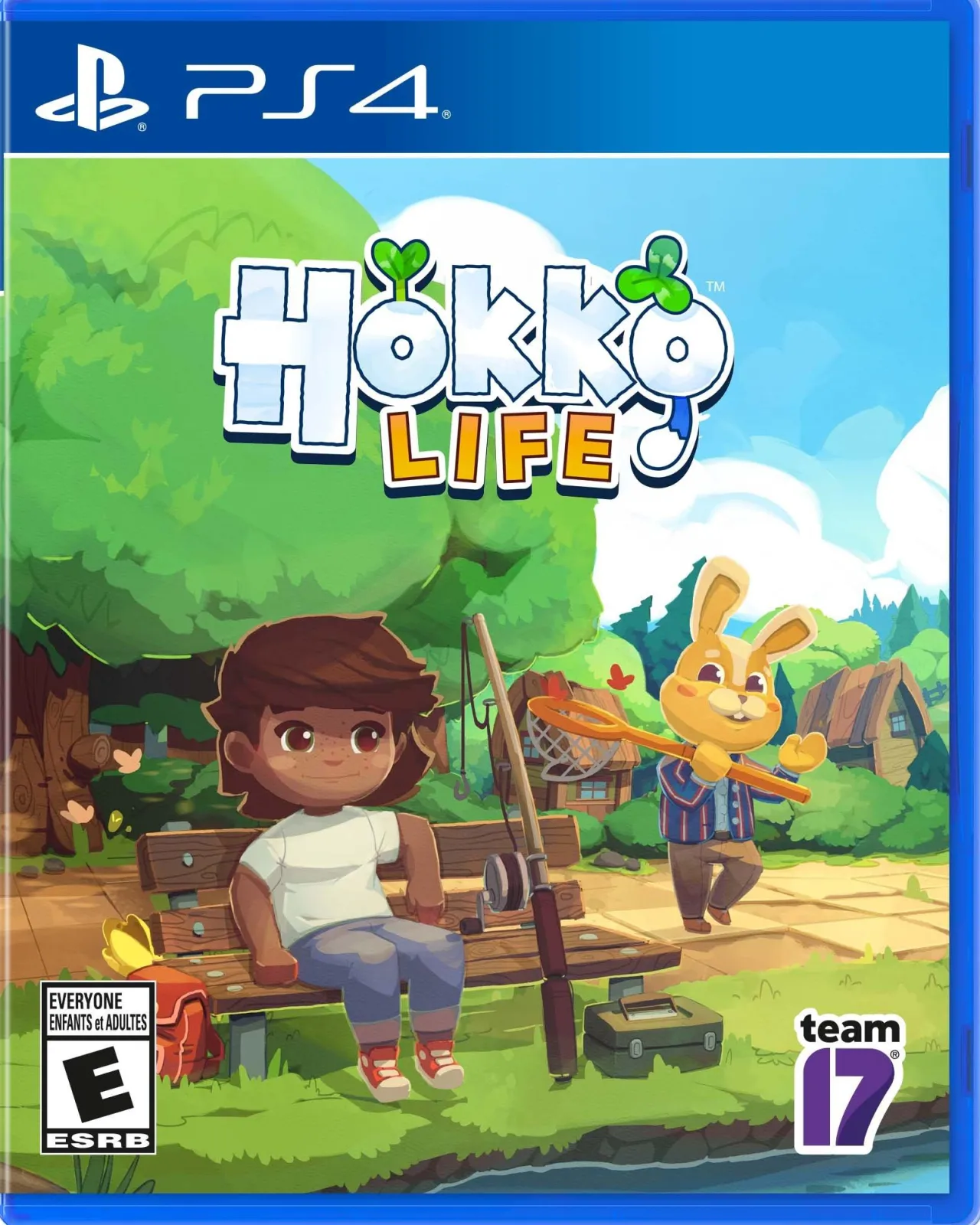
Review of Hokko Life: A Streetlamp-Thief Simulator
A review of Hokko Life in early access: a cozy village-life simulator among animals that, in the author's view, almost entirely copies Animal Crossing, with its only original feature being crafting furniture “from scratch”; the author notes bugs, the lack of storage and scant activities and does not recommend the game at this stage.
Video games teach us: it is dangerous to sleep on a commuter train. You may miss your station and wake up yawning, if not in some Silent Hill, then definitely in a place where trains have not run for half a century, at a tiny station, on a rainy night, with not the slightest idea of what comes next. Usually this is how horror games begin. And sometimes — even farming simulators. For example, the recently released early access Hokko Life. Our freshly created hero (or heroine), having dozed off on a trip from nowhere to nowhere, ends up in a small strange town where there are only a couple of houses and an impassable forest all around.
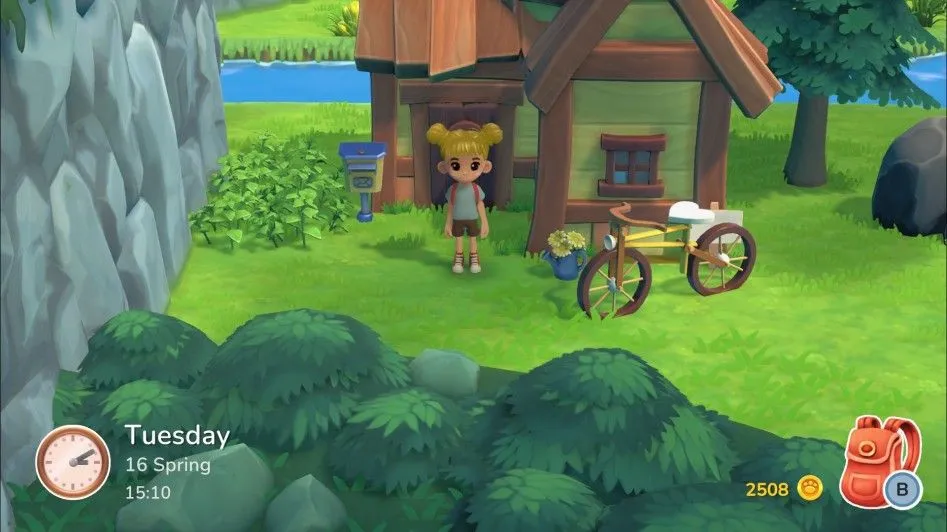
The town, however, is populated by rather sweet and friendly anthropomorphic animals; the hero is immediately found a spot in a storeroom, put to work — plant one thing, bring another, fix and patch up a third from above, and, of course, there is no thought of “leaving” anymore — after all, we are given our own house! And the town grows! And new little animals appear! The main thing is not to forget in the morning to plant ten blue flowers for crafting dye, catch fish, collect the shells that appear daily on the beach, chase butterflies with a net…
Do you recognize the tune from two notes and without Shazam's help? Right, that is the music from Animal Crossing.
Writing about Hokko Life without comparing it with Animal Crossing is utterly impossible. And it is not even about the animal residents (we have seen that in Garden Paws), not about the need to craft a lot of all sorts of things for a forgotten and barely existing little town (that was in My Time At Portia), not about the sweetly cartoonish universal style. It is simple: Hokko Life is a pure “I honestly stole it, myself, nobody helped me” (c) copy of Animal Crossing. You could say it is from AliExpress. Who has bought goods there? Do they resemble the originals? And is the quality the same? There you go.
Everything there is has been copied. As in AC, we build houses where fluffy residents move in, complete simple tasks, shop at a little general store (which even looks the same!), and gradually new interesting creatures drive into our modest urban-type settlement — sellers, dyers, designers, new shops and centers open… For money, as in AC, we catch insects on the lawn and fish in the local pond. We plant flowers, chop trees (true, there are only two types and no fruit ones), tap rocks with a pickaxe. You can dig up lumps of clay for crafting in the ground, and sand is obtained on the beach in the same way. Everything is familiar down to the last movement, like the road from home to the hot dog stand.
The differences are purely cosmetic. Instead of the ruthless raccoon businessman Tom Nook, houses are sold by the pig realtor Rose. In the shop instead of the same grumpy tanuki or his nephews, the giraffe Moss stands behind the counter. Instead of the hedgehog seamstresses Sable and Mabel, the fashion boutique is run by the goat Laurus; the beaver CJ, responsible for fishing, has been replaced by the bear Derris. We craft not at a workbench but in a workshop.
But the copied ears stick out everywhere: the painfully familiar round bushes, the uniformly green lawn of grass, neat little stones, a beach with a plank pier from which it is convenient to cast a rod…
What else? As in the, um… original, the “area of activity” given to the hero is at first limited — first by a river, then by a tall hill. You will have to, as in the you-know-what, build from improvised materials first a bridge and then a ramp or a staircase. Otherwise you cannot get to the far parts of the map at all. In the freshly built houses, by Rose's order, we have to place beds and lamps, which also have to be crafted; on the way to the pond where tadpoles can be caught, we need to stretch at least some kind of decking over the chasm near the waterfall…
And here the game's only original aspect comes into play. A really interesting one.
Unlike AC, where we were offered an assortment of ready-made furniture that we could at best paint in different colors, in Hokko Life crafting “from scratch” is available from the available parts (boards, carved, shaped and plain, cones, sticks, logs, stones, bricks, fabric, glass, pillows). We choose what we want to create — a chair or a bed, a table or a bench; and from there we have fun as we like. On a “table” it should be possible to put at least one object, on a “chair” it is desirable to sit at least at the edge, all splayed out; this can, of course, be ensured in a thousand ways, just look at the Ikea catalog. Even with the limited possibilities of Early Access, people are already having a great time making wooden bicycles, copper dishes and pillow forts. All from the most basic “cubes”, spheres and hemispheres, decorative pieces and rectangular boards. It turns out very interesting indeed. Naturally all this is strongly limited in size, and nobody will let you build a palace of sand and cones across half the map. But if you wish you can build a thousand little palaces and flood the whole village with them!
People who like such mini-3D design will be delighted. The craft puzzle seems hard at first, but once you turn objects around in it for ten minutes or so, the editor becomes intuitive. (If only it did not freeze every ten minutes! But what can you do — Early Access.)
The downside of this approach is that there is nothing ready-made for sale. Everything has to be made by yourself: beds, chairs, tables, shelves, desk lamps… Some pieces of furniture, as well as non-standard things (like a drum kit or a TV), are sold in the shop, the assortment is updated daily — you can look there. But copying the shop's haul in the editor to get, say, two chairs from one bought (or editing it by adding armrests to a chair) is impossible. The basic things (and the non-basic ones too) will still have to be crafted. Honestly, some basic furniture set would not hurt — if you need a stool, going to the workshop yet again and attaching four legs to a square board is already boring. You can, of course, be a minimalist, slap a single stump into the furniture editor and voilà — you can sit on that too! (But you want beauty, after all…)
Another early access trap: the lack of any storage at all, whether in the house, in a chest or in a goblin bank. Everything has to be carried in the inventory, and for a game based on crafting this means that there will be space in the bag never-ever. The developers promise to add some kind of safe for valuable dyes, shells and blades of grass in the next update, but for now — with a limited number of backpack slots — it is quite hard to play.
Progress in the game is quite uneven: something unneeded unlocks quickly, something story-related (for example a bomb to blow up a cave-in in the mine) has to be awaited as a random quest reward. There is practically nothing to do in the process: you can catch fish and butterflies — but all the newly discovered fauna is not handed over to a museum but is simply noted in an abstract “sticker journal”; and the pay for hunting feats is small, while money is needed constantly for new houses and furniture. What remains is to steal furniture from the neighbors (I am not lying) and carry it to the shop. You can also steal street lamps — and sell those too!
This is not Skyrim; here residents do not care even if you drag a bed out of their house right from under their noses. Still, Early Access and its eternal bugs provide many other funny ways to make money: for example, you can chop the endlessly respawning tree near the workshop, craft beds from a single wooden log and then sell each for 100 coins. Capitalism, ho!
On the whole, apart from the crafting system (well thought out, interesting, polish it a bit more — and it will be wonderful) there is practically nothing original in the game. Good copying is the key to success, nobody argues — and Genshin Impact confirms it with all its tentacles! — but copying also has to be done wisely, adding something of your own and not removing what makes the original interesting. For example, the residents of Hokko Life practically have no unique personalities, repeating the same lines over and over, so the choice of “whom to settle in the new little house” comes down to purely aesthetic. And bugs. Bugs, as was said, are many. Constant freezes, “English_string_missing” instead of item names. A couple of times I practically managed to softlock the game by cluttering the river with unsuccessful little bridges that could neither be crossed nor removed from the accessible bank. In the end the game, at this stage of early access, can be recommended only to those who shy away from the Nintendo Switch like fire and never plan to buy it in order to play Animal Crossing on that console.
(To my mind, it is better to download a GameCube or 3DS emulator and play any of the series' earlier games; there is more content there in any case. Or the mobile Animal Crossing Pocket Camp.)
Perhaps over time Hokko Life will gain some new features and grow interesting, non-copied possibilities — we will see on exit from Early Access. But for now it is simply an AliExpress-style copy of the original, with its minuses but without obvious pluses and bonuses. Except the crafting system, but it alone does not outweigh the many other problems.
Hokko Life was released on June 2, 2021, and the game is available for Windows and Mac OS.
Based on material from ProGamer. Translated from Russian.