Lazy Cabbage Rolls: A Review of Pikmin 1+2 for Nintendo Switch
A review of the Pikmin 1+2 compilation for Nintendo Switch: the original GameCube games almost unchanged — the same textures and a frame rate below 60 FPS; the author describes the real-time strategy of the first game with its 30-day limit and the calmer rhythm of the second (no limit, with underground dungeons) and calls the compilation a good way to get acquainted with the series.
While a new Nintendo console is awaited, the renowned Japanese company keeps carefully releasing 20-year-old classics on Switch. In addition to the release of the new, fourth installment of Pikmin, we are invited to recall how the series was born on the GameCube out of alien pistils and stamens. Right away we note that, unlike the Metroid Prime remaster released this year, where the developers at Retro Studios noticeably updated the graphics, this re-release contains only minimal cosmetic changes of a technical nature. The people responsible for the re-release did not bother to update the textures of the early 2000s or raise the frame rate to 60 FPS, which leaves a bitter feeling of disappointment in the heart, as if a good thing had been treated with absolute indifference.
The first Pikmin came out in an ambiguous era, when Nintendo was experimenting wholeheartedly with old and new titles, often shocking its devoted fans. The mysterious project, built from scratch under the direct guidance of Shigeru Miyamoto, fit into no frameworks at all. Describing the game's concept reliably on paper was decidedly impossible. It is at once a real-time strategy game, a puzzle and an adventure with survival elements and a limited timer. At the center of the story is a miniature space explorer, Captain Olimar, who crashes on an uncharted planet inhabited by amusing aliens called Pikmin, which combine the biological properties of plants and animals at once. There was a rumor that the game's original idea came to Miyamoto while the great game designer was watching the behavior of ants, but in one interview he noted that this was only part of the working process.
As befits a civilized colonizer, Captain Olimar quickly finds a way to use the naive natives for his own ends. With the help of a high-tech whistle, Olimar gains the ability to command the Pikmin as obedient workers and soldiers, and also to grow new ones like flowers in a vegetable garden. The hero and his henchmen pygmies… that is, Pikmin, hurriedly set off to explore the planet's surroundings in search of the wreckage of the crashed ship, since the captain's survival supplies will last only 30 days.
The time limit has always been a subject of controversy. Each in-game day equals about 20 minutes of real time, and given the rather slow pace of events the player has to plan their actions especially carefully. To successfully assemble the ship you have to spend time on all sorts of tasks, from simply studying the terrain to building bridges across water obstacles and fighting predatory representatives of the local flora and fauna. When the in-game day ends, Olimar and the Pikmin must evacuate from the planet's surface before sunset. If you fail to gather all the Pikmin at the base or simply forget about them, you will be “rewarded” with a scene in which huge nocturnal toad monsters swallow the defenseless Pikmin whole. By Miyamoto's own admission, with such a heart-wrenching moment he tried to develop in the player a sense of responsibility for the little virtual helpers. Although, judging by the reviews of seasoned players, they took nothing but psychological trauma from that experience.
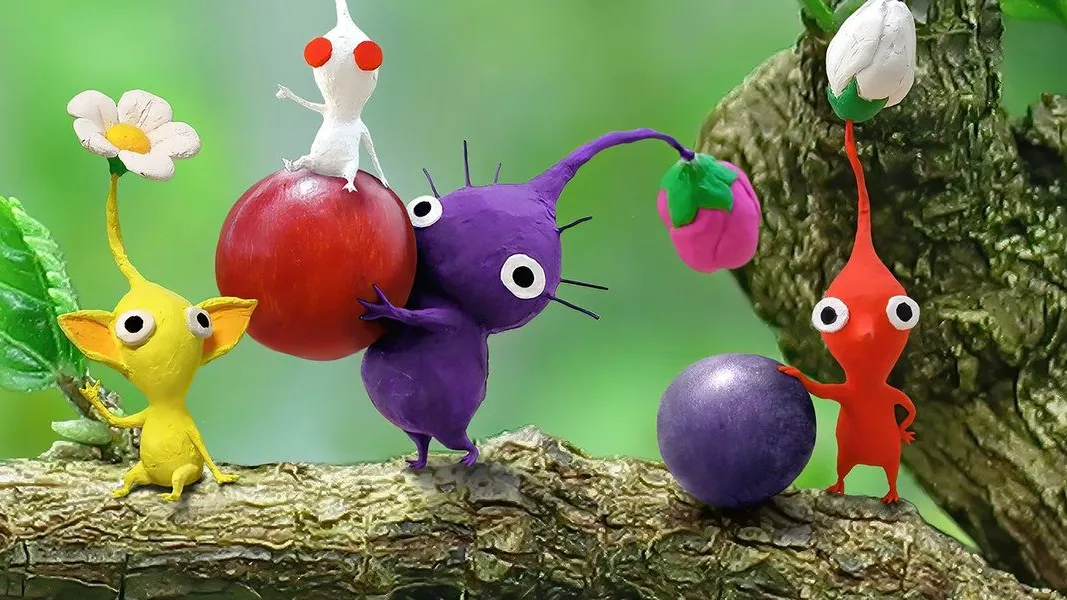
In the first game the Pikmin are divided by color into three subspecies: red — universal workers and good warriors; blue — they do not drown in water; yellow — very light and bouncy, which lets Olimar throw them onto unreachable heights. To increase the population the Pikmin must collect flower seeds of the corresponding color and carry them to the base, and after a while a new generation grows from the ground. The gameplay of Pikmin, despite its apparent oddities, is maximally intuitive and accessible to any category of player. The time limit at first feels like an annoying hindrance, but soon you realize how important it is for building up the right atmosphere. The game encourages you to make prompt decisions, analyze your surroundings, act efficiently and does not give you a chance to lazily exploit the mechanics.
Nevertheless, during the development of Pikmin 2 the wishes of critics and players unwilling to strain their gray matter excessively were taken into account. First of all, the game designers at Nintendo got rid of the time limit. From now on players could explore the locations and grow Pikmin at a pace comfortable to them. Following the story, Captain Olimar is no longer busy surviving on a wild planet but helps his boss pay off debts. To solve this task, taking along a bumbling helper named Louie, the captain goes to the planet of the Pikmin to collect valuable alien artifacts and then sell them for decent money. The irony of the situation is that the treasures the player collects are the most ordinary household items: batteries, bottle caps, soap, coins, a candle, a television antenna, a spoon, a chess piece, a diskette for the Famicom console and so on.
Compared with the first game the scale has noticeably grown. Locations became bigger, and so did the number of items to collect. Another novelty was the ability to switch between two playable characters, each of whom can lead an entire army of Pikmin at once without consequences for the smoothness of the gameplay. Having two playable characters, as well as the appearance of two new kinds of Pikmin, allowed the authors to make the spatial puzzles slightly more complex. The only problem is that if in the original Pikmin every piece found of the crashed ship was perceived as an achievement, accumulating money in Pikmin 2 quickly turns into work routine.
The situation is aggravated by the introduction of “dungeons” — underground labyrinths stuffed with loot. In essence each dungeon is several layers of similar dark corridors that must be passed in a row without saves, as in a proper “roguelike” — a pleasure, frankly, for a particular taste. And although far from all the changes benefited the game, the fundamental basics of the gameplay remained the same, which makes Pikmin 2 an extremely attractive game for lovers of unhurried grinding. We also note that at the time of release in 2004 Pikmin 2 significantly surpassed the first game technically, which suffered from an irritatingly low frame rate. In the re-release this difference is hardly noticeable.
The Pikmin 1+2 dilogy compilation is an excellent opportunity to get acquainted with the history of the series, especially if you have already played Pikmin 3 or Pikmin 4, released this year. The classics of the Nintendo GameCube generation can still give many modern projects a head start, but the technical execution of the remaster is nothing to write home about — these are all the same old games, re-released in HD.
Releasing the first two games on cartridges is an excellent opportunity for collectors of physical editions to gather all the numbered Pikmin releases on Switch.
Based on material from GameMAG. Translated from Russian.