Absolute Nightmare: The Callisto Protocol Review
A review of The Callisto Protocol: the author praises the graphics, lighting and sound, but sharply criticizes the dodge-based combat, the corridor linearity, the checkpoint system and the technical crashes, and advises waiting for discounts and updates.
Science fiction is the perfect foundation for creating new and vivid worlds. In the case of horror the setting also opens a bottomless pit for realizing the most varied ideas and artistic solutions. Relying on the wonders of science, faraway worlds and the boundlessness of dead space, truly frightening things can be brought to life. Nightmares that will stay with you for many years.
Opening Striking Distance Studios in 2019 under the Korean publishing label KRAFTON, the game designer Glen Schofield, who stood at the origins of the Dead Space brand, set himself a rather noble goal — to give the world one more original horror in the setting of a grim future.
Moreover, it was important for the developer to find the right balance — to create something fresh while at the same time satisfying the demands of fans who sincerely love the developer's previous cult game.
Following this philosophy, The Callisto Protocol really does begin with a careful quotation of Dead Space. The lone cargo ship “Charon”, piloted by Captain Jacob Lee and his companion Max, is making a routine delivery of components from the moon Callisto to the residential colonies. The ship's cabin is lit with a soft orange light, and nothing foreshadows trouble — the characters plan to quit their thankless job after completing one last big order.
But the long-term plans are not destined to come true. Jacob's ship comes under boarding by armed people, the vessel has to be landed in emergency conditions, which leads to a direct collision with the lunar surface. Coming to, the hero grasps the gravity of the situation — Max is dead, only ruins are left of the “Charon”, and guests are already knocking at the door.
Leon Ferris, the head of security of “Black Iron” — a giant prison complex located on Callisto and being the only human abode on the cold and unwelcoming land — comes to Jacob's aid.
Instead of help, Ferris arrests Jacob and without any protocols places the hero in a separate cell, having first fitted a special chip to his neck that allows one to “connect” to other people's memories and to see a person's vital signs plainly.
Enjoying prison life, however, is not Jacob's destiny. Almost immediately “Black Iron” is seized by chaos, screams ring out all around, something explodes loudly, and the alert system asks for calm. Leaving the cell, the luckless captain enlists the support of another prisoner, finds a heavy crowbar and meets the first monster.
It turns out that the complex is at the epicenter of an outbreak of an unknown disease that turns people into dreadful monsters. Jacob's only goal is to survive, returning home along the way.
Further on, for most of the game, except the last third, The Callisto Protocol will not pester you with its storytelling. The traditional notes and audio diaries are scattered here and there, “hidden” in the spinal chips of dead guards, but the main focus is on routine and everyday tasks — reaching the right sector, restoring power, finding a working ship. On the way to his goals Jacob faces a mass of obstacles, the overwhelming majority of which you will solve with powerful blows to the head.
Distancing itself from similar offerings on the game market, the debut project of Striking Distance Studios confidently declares its gameplay bearings from the very start. Forget pistols, plasma cutters and flamethrowers. Here your best friend is a heavy and angry stick. The stick can be used to hit, the stick can be used to knock. At first the stick offers only one basic attack, but if you invest in a certain branch of development there become two. You have to get used to the stick. You have to learn to love the stick. Because even before discovering the first firearm you will have to destroy at least a couple of dozen monsters with the stick.
The emphasis on melee combat may seem an interesting and striking idea, especially against the background of other horror games, which are almost always built on the opposite concept where enemies must be kept at a distance. The main thing is for the idea to be able to justify itself mechanically. Alas, The Callisto Protocol does not cope with the task.
The key gameplay aspect of the game is the system of dodging attacks. Jacob can dodge an opponent's lunges and then find a window for his own counterattack. In a word, it is all very similar to The Last of Us Part II, but with a few unexpected mutations.
To dodge in The Callisto Protocol you hardly need to watch what the opponent is doing. It is enough simply to move the left stick from side to side in sequence while the hero performs all the necessary maneuvers. No auxiliary buttons, timings or extra conditions, just swaying the thumbstick along a single axis.
Most of the monsters met in the game have a very limited attack pattern — monsters make from one to three lunges. When the series of enemy animations ends, it is time to attack — you hit with the club several times, then retreat into defense again. That is all. The gameplay works on this principle from the first hour to the last.
And everything would be great provided the mechanic described above worked like a well-oiled mechanism. That does not happen. Despite the simplest implementation, you will constantly run into unpleasant surprises. Thus, damage to the character can land even upon a successful dodge — the animation plays, and the health points vanish. Sometimes Jacob gets stuck in the surrounding geometry, because of which the dodge works incorrectly. But the genuine horror begins as soon as two or more monsters appear on screen at once — at such moments you will be overcome by animal terror in its purest form.
The melee system in The Callisto Protocol is not designed for several opponents at once. In such situations there are still tools and options that let you win a small but real advantage. Nevertheless, there is no way to get rid of the feeling of frustration.
When a monster approaches Jacob, the game locks the character onto the nearest opponent with an iron grip. All further attacks with the stick are automatically magnetized toward the chosen target. The game's standard dance of dodges and exchanges of blows takes place. And if you are unlucky and another enemy comes into view, the system breaks down completely.
You cannot choose the optimal target yourself. Jacob will switch chaotically from one creature to another, taking damage from all sides along the way. You will not be able to dodge attacks either — the monsters hit simultaneously and fast, crudely violating all the rhythms previously set by the designers. Sometimes quite comical moments occur, when during a fight with one enemy another comes up behind you and initiates an attack. In such conditions Jacob may automatically dodge a lunge that you had no power to see, turn his back on the first opponent and drown you in an ocean of complete disorientation.
High mobility could have been a lifeline. For example, the character could quickly turn around, move and go around the monsters. I will dash the hopes — Jacob cannot do that. There is no convenient 180-degree turn in the game, the hero runs stiffly and with a creak, and an attempt to run around enemies turns into a nightmare — instead of a marathon to a safe position Jacob starts yet another series of dodges. The pinnacle of design thinking, which put dodge and movement on a single gamepad control, will haunt you for a long time in frightening dreams.
A little later melee gains extra depth through the leveling system. Thus, besides the ordinary attack you can make a strong and “charged” variation. This blow is somewhat slower, but it knocks enemies back a considerable distance. There is also a block, but the need for it is minimal — it is almost always more advantageous to resort to the familiar dodge.
Fortunately, at some point The Callisto Protocol does hand you a firearm after all. The final arsenal is made of a familiar set — two pistols, two shotguns, an assault rifle. Ammo is limited and is collected from caches found in the location, drops from monsters and bought in the shop.
At the game's best moments you even manage to temporarily forget about the psyche-scarring melee and start deftly shooting the freaks. Hit accurately, they burst into fountains of blood, limbs fall off, heads pop. Spirited and beautiful.
There is no tactical depth on this gameplay layer either. The weapons differ little from one another and are not designed for specific situations or enemy types. You simply use whichever gun you have ammo for.
But the party cannot last long, and The Callisto Protocol drags you by force back to your beloved trusty stick. The game introduces a new mechanic tied to melee — the quick-shot system. Thus, at the end of the usual combo attack of three blows you can press the aim button, after which Jacob automatically focuses on the enemy being beaten and deals critical damage to it.
The idea is perfectly understandable — to weave firearm and stick into a single hurricane of death, creating dynamic scenarios where you constantly have to close in on and part from an opponent. Once again the technical implementation lets it down.
At the end of a combo series a special icon lights up on the monster, because of which the aim button temporarily activates auto-aim on one specific enemy. Often you will find yourself in a situation where another creature is nearby, but you cannot freely aim at it — the game demands that a quick shot be executed, which at times can be completely counterproductive.
Quick shots are also broken by the inconvenient process of switching weapons. The entire available arsenal is placed on a floating vertical menu, and to change guns you must not only choose the item you want beforehand but also confirm the action with an additional button. Performing all these manipulations in the heat of battle is simply inconvenient. The game has a possibility of quick switching between two weapons, but it works unreliably — sometimes the press is simply not registered, which inevitably leads to death or loss of health.
On the subject of death — you will have to die often. Especially if you have the courage to start the playthrough on a high difficulty. Getting to know the game in that case turns into an absurd attraction, where some of the gameplay sections are constructed in such a way that you simply cannot pass them “in a rush” — you need to know exactly the location of every freak and optimize your actions according to a drawn-up plan. You cannot find out in advance that an exploding monster is sitting around the corner. Nor can you react promptly. So let us watch a caricatured and grotesque death animation lasting twenty to thirty seconds and try again. In this context the news that the season pass for The Callisto Protocol will include as many as thirteen additional animations of Jacob's killing sounds even more comical — at Striking Distance everyone understood.
The game takes a certain pause in tempo roughly in the second third, when a new type of monster is put on the stage — blind creatures. Blind and, apparently, deaf as well. Unlike the three other kinds of opponents, who prefer to wave their limbs aggressively, these freaks are to be dealt with quietly. Jacob can sneak and perform lightning kills with a sharpened shiv. It all looks very funny — the character growls and cuts the monster with a sharp object, the monster screams and twitches, and its friends passing nearby do not even think of paying you any attention.
In this same section the game honestly tries to seem atmospheric and tense. The overused trick with an angry flea jumping out of loot crates will by now have thoroughly tired you, so slowly shuffling zombies bring the needed variety. And they also remind you that The Callisto Protocol is supposedly meant to scare. You can hardly get badly frightened, but the attempt is worth noting.
The last piece of the combat system mosaic in The Callisto Protocol is the gravity glove. Describing its principle would be excessive, but just in case I will clarify — it lets you lift and throw objects, including interactive scenery and the monsters themselves. Among other things the glove is also your main tool for controlling large groups of opponents. If opponents surround you, the best option becomes to hurl one of them onto the nearest trap or beyond the arena, thereby saving your own life. The trouble is only that it is better not to count on the glove's responsiveness — when trying to pull a nasty monster, all sorts of junk will keep landing in your grasp, which again leads to Jacob's jaw being torn off and a checkpoint reload.
The word “checkpoint”, by the way, you can immediately add to the list of the most caustic and vicious insults, because The Callisto Protocol will knock any pleasant associations with this term out of you by the middle of the playthrough. For some unimaginable reason the checkpoint system in the game is created with two aims — to waste your time and to provoke righteous anger.
Thus, the game relies on autosaves that happen every five to ten minutes of gameplay segments. Standard practice. The nonstandard practice is the positions where The Callisto Protocol saves its progress.
Having entered a new section you may spend a few moments collecting scattered resources, then move to another room where an angry zombie beats you to death. Restart. All the resources previously collected lie around the room again — you need to collect them anew. And now imagine that this is not about a small room but a wide corridor which you will have to run along two, three, four times. All because the game cannot initiate a repeat save.
There are other pleasant moments too. Sometimes a save point is located before a cutscene. The cutscene is beautiful and long, only it cannot be skipped. Because of this every new death throws you back to the start of a cutscene already learned by heart. But you watch it again, and again. There is no choice anyway.
Or yet another scenario. In The Callisto Protocol there are upgrade benches. On them your equipment, the sacred stick of death and the rest of the weapons are improved. It all happens expressively slowly — a 3D printer shows you how new elements are layered onto the model of a pistol, a cheerful tune plays, and life, on the whole, is looking up. Having finished with the upgrade, you quickly reach the next arena with monsters. You die. The checkpoint returns you to the upgrade bench. All the manipulations done before have to be repeated — the game did not save your progress. Just as slowly, and with a cheerful tune.
I would like to recall the developers with the warmest words when The Callisto Protocol decides to break spontaneously with a critical error. Over the eight hours it took to complete, on PlayStation 5 the game managed to “crash” four times. Each time reminding of the magnificent implementation of the save system.
Curiously, the project also provides “manual” saves, implemented through the pause menu. But functionally they merely make an additional copy of the last autosave. Why and what for? Perhaps we will never learn the answer.
But still, despite the negativity caused by the combat system, passing a cruel verdict on the project may be somewhat premature. Ultimately games are large-scale, multi-stage mechanisms assembled from a boundless number of component parts.
From The Callisto Protocol you expect not only fights with unusual and frightening little nightmares but also interesting navigation. After all the setting is intriguing — a grim prison, evil corporations and terrible secrets. You anticipate a web of complex design constructions, a search for secrets, optional paths and rewards.
There is none of this in the game. The Callisto Protocol is maximally linear. In the most direct interpretation. You always move exclusively forward, strictly in one plane, without pauses or significant branches. You will not find puzzles or interaction with the environment either. The most that will be required of you is to remove a fuse in one corner of a room and place it at another lever. Door, corridor, door, corridor, door, corridor. It is impossible to get confused or lost.
Yes, sometimes a level splits into two branches. One of them is the road to the next point of story progress. And the other is a tiny nook where extra ammo or upgrade resources may lie. At best such passages “loop” into the main corridor, after which you continue on. But more often you simply have to run back to the right path. At such moments it is better not to forget the sanity-threatening checkpoint system, because if you die on the way out of the optional corridor, all the treasures found in it will have to be collected again.
On the other hand, no one says corridors are a mortal sin. In certain contexts sequential levels with a strict structure can give many strong impressions. Designers have the opportunity to create memorable sections, complex arenas, interesting transitional states, clearly curating all the player's actions.
The memorable sections of The Callisto Protocol are the descent down a sewage pipe where you are being chopped by the blades of a big propeller. The complex arenas are square boxes spawning drooling green zombies in the corners. The transitional states are endless, never-ending vent shafts and narrow passages that put to sleep any enthusiasm.
Apparently there are at least a few people at Striking Distance who take perverse pleasure in claustrophobically tight spaces. In the good tradition of modern design tricks, the loading screens in The Callisto Protocol are hidden behind moments where Jacob strains hard squeezing into yet another crack. It is hard to take offense at that — technical limitations demand compromises. What turns out to be unimaginable is the number of such scenes and their duration.
A single vent shaft may have up to four turns. Having climbed out of it, you will need to duck and crawl a few more meters under a web of heavy pipes. And then lean against the wall and squeeze into yet another very narrow spot. Without end, without respite, without meaning or purpose. Throughout the whole game. At such moments you can entertain yourself with all sorts of things. For example, imagine that Jacob is a mole-man living in an amazing metal world. Or you can pick up your phone and scroll the news feed — nothing is happening in the game anyway.
Sometimes it seems the vents and gorges of The Callisto Protocol exist somewhere on the verge of outright parody. There is even a moment where behind a tiny crack in the wall a big plot twist is hidden. You crawl through the crevice, get your coveted trophy, and crawl back. Amazing.
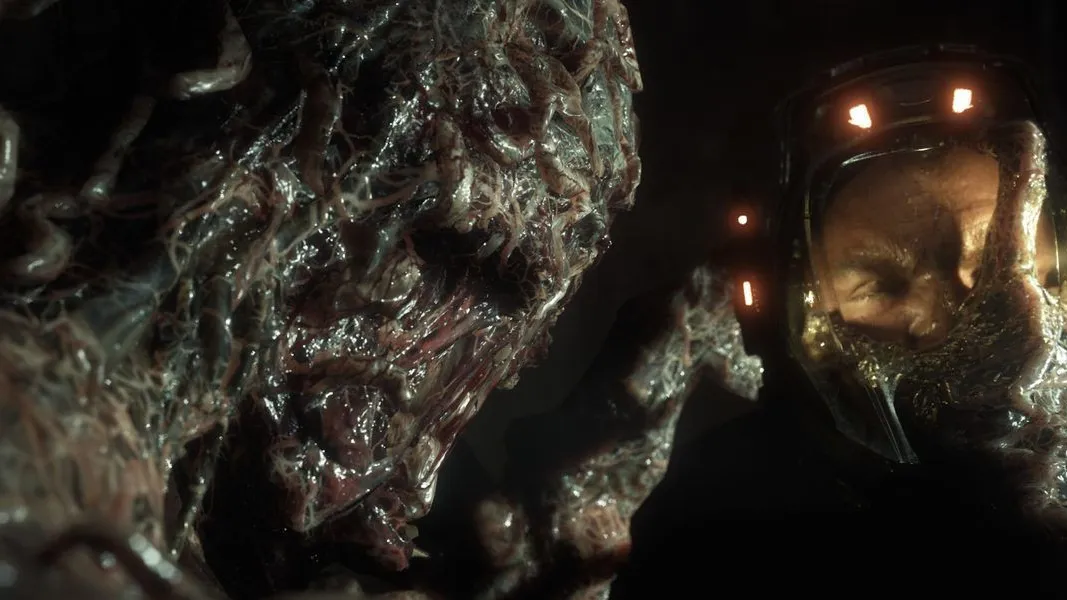
Fortunately, between the pointless fights with zombies and the clearing of shafts the game truly delights with its outward aesthetics. The artists of Striking Distance are people who did their work at the highest level. Without a shadow of doubt, The Callisto Protocol may fittingly be called one of the most beautiful games available on PlayStation 5.
All the graphic elements without exception deserve praise. Animation, work with materials, lighting. All the locations are riddled with details, easily and effectively convey the needed moods, giving the scenery the necessary naturalness and authenticity.
The lighting specialists deserve special mention. Almost everywhere The Callisto Protocol assembles on your screen contrasting and complex visual sketches where dramatically placed lighting organically draws attention to the complex geometry of three-dimensional spaces.
The sound designers approached their tasks with similar diligence, having assembled a powerful library of effects for the game and managed to integrate them successfully into the environment. The overall sound background does not try to stand out from expected norms, but even without that it fulfills its purpose perfectly — everything sounds loud and juicy.
The tragedy is that all the merits of Striking Distance's technical department in The Callisto Protocol turned out to be buried by dubious game design decisions. To every interesting idea the project responds with mediocre implementation. The game runs and immediately stumbles. It gets up again, but only to fall harder the very next moment.
The interweaving of melee and firearms is interesting. Suffering from a pointless dodge system, identical swings of the stick and a meager arsenal is not interesting.
Talented actors in motion-capture suits with the most genuine sincerity played out many little scenes for you. The Unreal Engine made it possible to render them with frightening fidelity. Only the little scenes turned out to be part of the script of a children's matinee written by a bored and not the most creative author.
The environment is the most beautiful and brightest reflection of the cult clichés of modern science fiction. You will not have time to look at it and interact with it, true — it is time to climb into your own ten-meter shaft.
You are also unlikely to spend more time with the game than the first playthrough requires. At release The Callisto Protocol offers no additional content, new-game mode with kept progression, rankings, modifiers, costumes or anything else. In time Striking Distance Studios' brainchild should accumulate updates, but in its release state a bare minimum awaits you.
One also wants to believe that the most noticeable problems, like the insane save system, the developers will manage to fix in the near future. Such improvements will not be able to change the overall game core, but will definitely spare you extra stress.
The Callisto Protocol seems to draw inspiration from the monsters it invented itself. The creature is expressive, dreadful and terribly attractive. It is interesting to look at, but close acquaintance with it is better avoided for now — beneath the greenish skin lies a meager inside.
If you really want to play The Callisto Protocol — better wait for discounts and updates.
The screenshots for the article were taken in performance mode on PlayStation 5. The game was completed on a high difficulty level and tested on a medium one.
Based on material from GameMAG. Translated from Russian.