What Happens If You Cross Berserk and Devil May Cry? Soulstice Review
A review of Soulstice: the author praises the flexible Devil May Cry-style combat, the progression system and the accessibility options, but criticizes the final mission with a static camera, the technical flaws and the monotonous music.
At the turn of the nineties and the two-thousands the team of Hideki Kamiya was working on the concept of Resident Evil 4. Various experiments with the combat system and a bug seen by chance in a neighboring team eventually led to the creation of Devil May Cry — a largely revolutionary and dynamic slasher. The series turned out successful and popular, and in that time Kamiya managed to leave Capcom and launch Bayonetta. But even today the DMC concept does not seem worn out, and every new game in that vein is received by fans with great enthusiasm. While everyone waits for Bayonetta 3 and some news from Capcom, the Italian developers from Reply Game Studios released Soulstice — a dynamic action game with gameplay close to Devil May Cry and a visual style reminiscent of the manga “Berserk”. It is a quite intriguing combination that seems fresh and unusual.
Before the start of the first mission the developers offer to customize text display in detail. You can choose a typeface with or without serifs, as well as the degree of subtitle shading and several other parameters. The game is translated into Russian, which certainly pleases, but the quality of the adaptation is very weak in places. For example, the inventory has two items “use” and “use”, one equips the item to the quick-access panel and the other consumes it at once. Also, in the Russian dialogues one often finds phrasings such as “she went” in the masculine form or “he went” in the feminine form and other errors.
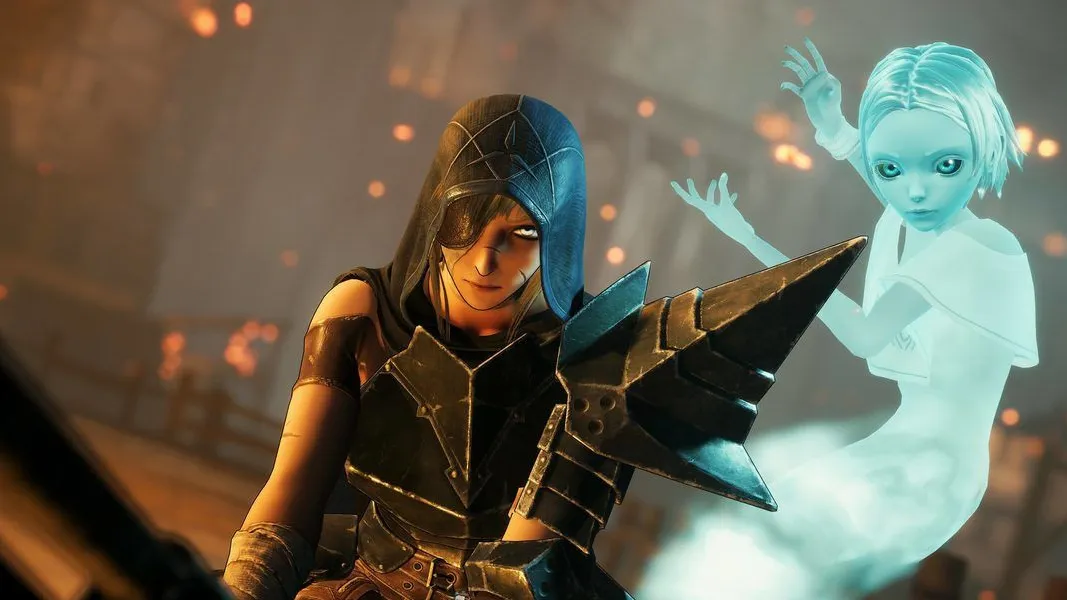
After the first settings and an exposition story, the player gets control of the main characters. Briar and Lute are sisters bound in one body by a magical ritual. They are members of a certain Order of the Ashen Knights, who have arrived in a ruined city teeming with monsters. Their task is to figure out what is going on and close the breach between worlds. The plot seems typical for such works, but as you progress, interesting details and intriguing particulars of the two sisters' past are revealed. The story stays within the paradigm usual for the genre until the very end, but it has its own unexpected turns and interesting situations. Despite a somewhat boring start, by the sixth chapter the narrative picks up.
The gameplay in many aspects repeats Devil May Cry. Here too you have to run from one arena to another, and between them solve simple puzzles and explore locations in search of valuable items. As you progress, the warlike Briar gets seven different types of weapon at her disposal. Each has its own purpose. For example, the hammer breaks shields well, the iron gauntlets knock down armor better than the others, and the bow is excellent for eliminating flying enemies. However, outside their intended purposes the balance of power seems uneven, because the hammer combines a good attack radius and relatively strong damage, which despite the weapon's slowness make it very effective against most enemies — even against some flying demons. But where the hammer proves too slow, the bow and whip come to the rescue, helping to deal with fast and winged opponents. The power of their blows is very weak even after upgrading, so some fights with fast monsters can drag on. The other weapon types, such as paired daggers and tonfa clubs, seemed less effective to me.
In the sisters' teamwork Lute does work no less important than Briar's. The ghostly girl can manipulate energy fields which, depending on their color, can reveal hidden objects or make certain barriers and obstacles vulnerable. Red or blue domes also reveal the vulnerabilities of enemies of the corresponding shade. The main feature of the mechanic is that Lute cannot hold this energy field for long and it has to be switched on and off depending on the situation. If you do not keep track of it, Lute will vanish for a few seconds and will not be able to help her sister for some time. To prevent such an outcome, especially in the heat of battle, you need to let the girl rest from time to time and level up special skills that release the strain on successful actions in combat. It is worth noting here that, unlike the similar mechanic in DmC, here it is done more carefully and conveniently. However, if this element is not working out for you, the accessibility options have the ability to automate this process.
As for defensive skills, Briar has a sidestep dash. But this mechanic works without connection to the others, so it does not interrupt attacks and has a very short invulnerability window, which makes the move situational and of little effectiveness in fights with large opponents who strike with sweeping area attacks. This is especially noticeable at the end of the game, when large enemies appear more and more often on the arena.
One of the interesting features of the game is the “Unity” mechanic — a powerful boost and acceleration of all the sisters' combat actions. It is something similar to “Devil Trigger”, but it is unlocked differently. The “cohesion” indicator rises if you successfully combine Briar's and Lute's actions, and falls after missed hits. If during a fight you take no damage and attack the demons in varied ways, the indicator will glow purple and you can activate this powerful state. In large battles it is realistic to reach this several times. However, because of the specifics of the dashes, for a long time I could not avoid enemy attacks, so I only found out how the mechanic works in the second half of the game, when I got used to the timings. Although if this point seems too difficult, in the options you can automate Lute's actions, and then this greatly simplifies the task of mincing monsters in unison.
Incidentally, there are quite a lot of different enemy types here that require a unique approach. Already at the very start the player is attacked not only by ordinary soldiers but also by annoying spear throwers who try to stay away from the fight and hurl large javelins at the sisters from afar, a bit later armored giants appear, then ghosts, flying harpies, monsters possessed by demons and many others. Each opponent demands its own approach and a certain algorithm of actions from the little sisters. For example, some monsters have an energy shield that must be broken before attacking, and in a fight with a possessed one you first need to knock the demon's spirit out of the body and then attack the ghost before it returns. The developers tried to compose the waves of enemies so that the player does not tire of repetitive battles and gets used to new conditions gradually. Often you are first given a chance to try your strength against a new opponent in simple conditions and sometimes even in one-on-one combat, and only later is the new enemy type added to the general pool. Closer to the end there are fights where you need to use the whole arsenal and the experience accumulated during the playthrough, which is perceived as an interesting test of mastery and gives the necessary sense of epic scale.
The transition between arenas is often accompanied by solving simple puzzles with crystals or some kind of chase. The developers tried to diversify this element of the game and often add new conditions or mechanics to familiar situations of exploring a location. All this lets you take a rest from fights, listen to dialogues or get plot-important information.
On the whole the combat system in the game is very flexible and responsive. In many moments it is that very DMC with a few interesting touches such as “Unity”. Here the combat mechanics demand skill and timing, but with a flexible settings system that lets you simplify the mechanics that do not work out or that you do not like. The Italian team managed to repeat the work of the Japanese masters quite worthily in terms of fights and some elements of game design. Although the developers still have things to work on, the combat system can be considered a strong side of this game.
Another important element of Soulstice is the sisters' progression. As levels are completed the heroines collect red and blue crystals, some of which are awarded for beautiful and varied combos at the end of each arena. These gems serve as the local currency, which can be spent on useful items at a merchant or on upgrading various abilities. The development of Briar's skills is quite typical for games of this kind. There is a list of weapons and moves that can be unlocked one by one for red crystals, while Lute's progression is more like a branching skill system typical of role-playing games, divided into several directions. In many ways Lute can be tuned to your play style, although closer to the end most skills can be leveled up evenly.
After such praise it somehow does not feel like scolding Soulstice, because it is clearly visible that a relatively small team created a quite decent “AA project”. However, it did not go without rough edges and archaic decisions such as a static camera in some scenes. This often makes the picture more cinematic but interferes with character navigation. For most of the game this approach poses no serious problems, but closer to the end there is a chase episode that ruins everything. This mission has to be completed within a certain time, and besides several drawn-out fights there are platform sections that turn into sheer hell because of unfortunate camera angles. Sometimes it is simply impossible to land on the right ledge and you have to jump almost blindly. The most irritating moment lurks at the end of the mission, when very little time is left. With a convenient camera placement this segment would have added rhythm and extra tension, but in the end the wrong angle turned it into a serious problem. Its essence is simple: the player has to hold the right aura and race across the platforms. Everything has to be done quickly, since some of the ledges fall away and do not let you aim properly. Besides, if you use the aura carelessly, Lute gets tired at the worst possible moment. If you miss once, the little sisters fall down, losing an enormous amount of time on the climb back, which most likely will no longer be enough for the final stretch of the mission. In essence this mistake at the end means defeat, and if Briar nevertheless manages to reach those ledges, you will again have to jump without precise aiming. If the timer runs out or the characters die, the chapter starts over, because there are no intermediate save points here. This mission is so irritating that at some point I wanted to delete the game and never return to it. If not for this review, I would have done so. It is an obvious miscalculation of the game designer, and the developers simply must somehow fix it.
Now let us move on to the visual side. If the gameplay rests entirely on DMC, the visuals largely refer to “Berserk”. The characteristic design of segmented armor with sharp edges and the big swords of the Ashen Knights recall the works of Miura, and the gloomy setting of stone fortresses plunges you into the harsh atmosphere of this world. However, this has its nuances. Since the environment and the characters' armor in the frame seem monotone and merge with each other, the developers applied a light cel-shading effect. Because of this outline, jaggies can often be noticed around the characters in the frame.
On the whole the technical side of Soulstice is far from perfect. The developers offer three modes. “Resolution” — good anti-aliasing and texture quality, but the frame rate is capped at thirty. “Performance” — a high frame rate, but muddy textures and very noticeable jaggies. However, even in this mode there are very slight slowdowns and judder when moving the camera. Despite the high tempo of the gameplay, the option feels uncomfortable for long play. The eyes tire quickly. The third mode is “balanced”. In it the frame rate floats, small jaggies are noticeable, light jerks remain when moving the camera, but at the same time there is the necessary smoothness of motion, and the sharpness of the picture is not much inferior to the “resolution” option. After testing all three options I settled on the balanced one.
It is worth noting that the image judder present in all modes may come from uneven frame duration. For example, at 60 FPS the picture should change 1 time every 16 milliseconds, and in that case the image flows smoothly and evenly without jerks. However, if within these 60 frames the duration of each fragment is uneven, for example one lasts 15 ms and another 17 ms, it will affect smoothness even in modes such as “performance”. Something similar can also happen because of broken synchronization between the work of the CPU and the GPU. Be that as it may, the developers clearly lacked time and money for additional optimization for specific hardware even on new consoles. In our case it is the PlayStation 5.
In closing, the musical accompaniment should be mentioned. It is quite interestingly conceived here, but as with the environment design it suffers from monotony. The idea of combining orchestra and electronics is quite interesting and to some the music may recall the soundtrack from Motorstorm Apocalypse. Here, however, the compositions seem simpler and more uniform. Besides, the very idea of combining dark anime-style fantasy with rhythmic electronics may seem strange, although it does add the needed drive. So the main problem of this soundtrack is not the choice of genre but its monotony and facelessness. Personally, after finishing the game I did not feel like adding the music from Soulstice to my player.
Soulstice is an inexpensive but engaging and interesting slasher with some regrettable missteps in the final stage of the game. Considering that projects with such a combat system do not come out as often as one would like, the creation of Reply Game Studios can really please fans of the genre and brighten the wait for the third Bayonetta or the announcement of Devil May Cry 6. The game also deserves attention from fans of the manga “Berserk”, and the wide set of accessibility settings will let even players with no experience in such games enjoy the spectacle.
Based on material from GameMAG. Translated from Russian.