Tropical Princess: A Review of Tchia
A review of Awaceb's Tchia: a beautiful, friendly open-world adventure inspired by New Caledonia that borrows heavily from Breath of the Wild; the author praises the atmosphere and the variety of mechanics but finds it toothless, derivative and too eager to educate.
New Caledonia is one of the most mysterious places on Earth. These isolated islands in the Pacific Ocean are a genuine time capsule, because their ecosystem has preserved a truly prehistoric look. It is these landscapes that are often used for all kinds of pseudo-documentary scenes with computer-drawn dinosaurs. In the age of colonialism New Caledonia became — and still remains — a zone of French influence, so it is no accident that the adventure game Tchia that reached the editorial office, created as a tribute to this exotic island, was developed by French-speaking Canadians from the independent studio Awaceb, based in Montreal. Let us see what they came up with.
The French are known for their love of the beautiful and for an extraordinary view of things. In the video game world, it is worth recalling such luminaries of game design as Benoît Sokal and Michel Ancel. As for Tchia, here too we have a very ambitious project. On a limited budget the developers aimed at a large-scale open-world game with numerous mechanics. The story is about a teenage girl named Tchia who lives with her father on a tropical island. Note that although the authors were inspired by the real New Caledonia, absolutely everything in the game is fictional and fantastical — almost like in the “Syberia” series of adventure games from the already mentioned Sokal.
Tchia's life goes on in its usual way. At her father's behest the girl gathers fruit, dives for pearls, tends the vegetable garden and, in a free minute, pets turtles and other peaceful creatures. In the evenings they sing soulful songs in the local tongue, using tree leaves as a musical instrument. Of course, such a vanilla idyll could not last forever, and one day her father is brazenly kidnapped by some nasty villains and taken away to a gloomy-gloomy tower à la the Citadel from Half-Life. Without further ado, Tchia not only realizes she is a Mary Sue from the island of the Bounty chocolate bar, but also discovers in herself quite distinct superpowers. In these conditions there can be only one path — run to save dad.
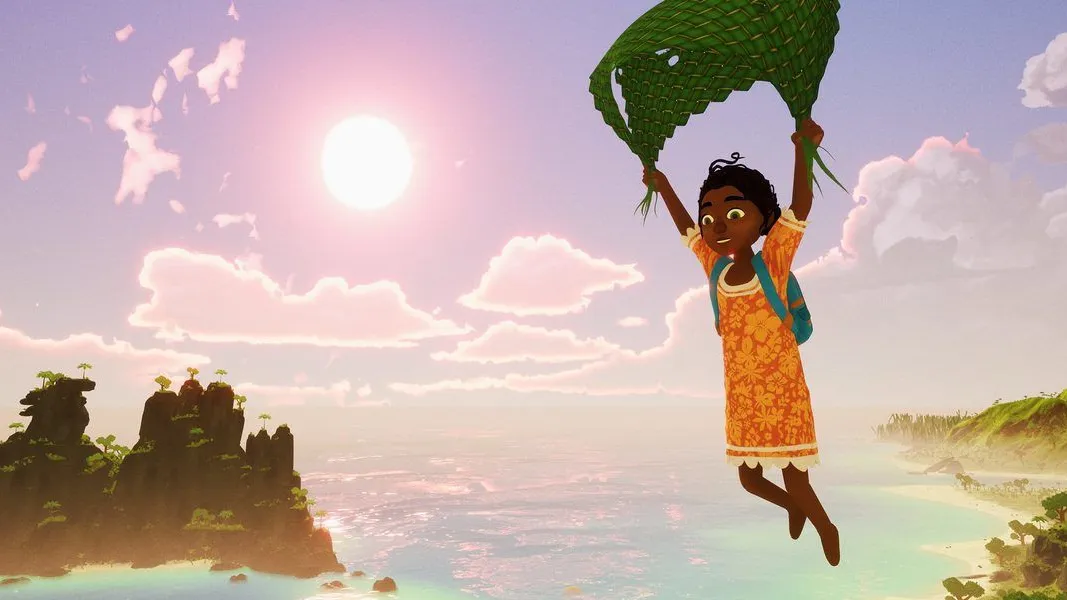
Seasoned players can hardly be surprised these days by landscapes of tropical jungles, beaches and the sea under the sun. In this respect Tchia is not a revelation and simply copes well with its primary task — conveying the atmosphere of a trip to the islands of New Caledonia, with their specific nature, the freshness of ocean air and the blindingly bright sun filtering through the foliage. The conventional style and hypertrophically smooth character animation recall something between The Legend of Zelda: Breath of the Wild and the adventure Rime. The artists especially succeeded with romantic sunsets, when the sun's disc dives into the boundless surface of the ocean, flooding everything around with a fiery orange haze.
In terms of gameplay, Tchia sends a big and warm hello to the same Breath of the Wild and some other open-world projects. The influence of the latest “Zelda” is felt most clearly. The developers tried to recreate such elements of the Nintendo megahit as a full physics engine that lets the heroine interact with the most varied game objects, and even paraglider flights, which here takes the form of a big palm leaf. Veteran gamers should also appreciate the references to classic masterpieces.
As she progresses, Tchia will learn to play specific melodies on a magic ukulele, which will let her change the time of day just like in The Legend of Zelda: Ocarina of Time, and will also discover in herself the gift of possessing various living creatures and inanimate objects, taking over their physical properties — this simultaneously recalls The Legend of Zelda: Majora’s Mask with its system of changing masks and a Nintendo exclusive many have forgotten called Geist, released on GameCube. Such live transmigration of souls will help to explore the world, find items, solve puzzles and so on. Traveling between islands on a raft, in turn, recalls yet another “Zelda” — The Wind Waker. It is obvious that the developers are not lacking in good taste, love playing various games and understand what to copy and from where. There was room, too, for the ubiquitous “towers” — without them it is like New Year without Olivier salad.
The abundance of reasonably implemented, sensible mechanics and mini-games, multiplied by convenient controls and a concise open world of adequate size, lets Tchia stand out among other games trying to seem like AAA-class projects on a limited budget. In this context, perhaps the main problem becomes a certain “toothlessness” of the game. In almost every aspect of gameplay, story, art design or music the authors take the path of least resistance. Playing Tchia is pleasant and comfortable, but sometimes the comfort becomes cloying: you are given a lot of interesting mechanics, but you will not meet serious difficulties and obstacles, the curious lore is not revealed to the end and does not offer genuinely sharp themes in the narrative. The audiovisual design seems to please the eyes and ears but feels somewhat bland, secondary. Tchia treats the player as friendly as possible and at a certain point this begins to be frankly annoying.
Imagine that you have come to a resort for a good rest, but a guide follows at your heels, there are no entertainments other than health and educational procedures, and the menu is exclusively dietetic food — as if you had ended up in a nursing home or at a congress of radical ecologists. In its desire to please everyone and be tolerant of everything, Tchia becomes more like a charity project of UNESCO than an engaging video game. This is felt especially when the developers put particular emphasis on the presence in the game of the Drehu language — the authentic speech of New Caledonia's indigenous people. This is wonderful in its own way and extremely curious from an ethnographic point of view, but within the game it somewhat weighs on you with its deliberateness.
Playing Tchia, it is impossible to shake the thought that you are inside a beautiful educational project in which the game mechanics play only the role of bait for gamers who need to be told an instructive story.
Based on material from GameMAG. Translated from Russian.