Tower Fortress
A review of the mobile action roguelike Tower Fortress on PC: the bright style and well-thought-out mechanics suit a phone, but on a big screen the game looks mediocre and the outcome depends too much on chance.
Given the sheer number of games on Steam, it is quite understandable why many players try to avoid games not made for PC. Steam has quite a few ports from other platforms, and most of them are done with the care of a small child scattering toys.
But Tower Fortress is not one of them and can boast striking visuals and well-thought-out gameplay mechanics — which is really great for phones. However, precisely because of these same features it looks mediocre on a big screen and really helps draw the line between games on PC and on mobile platforms.
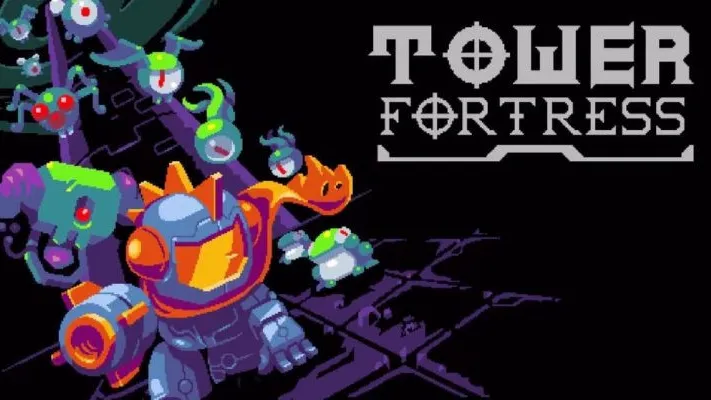
Tower Fortress is an action roguelike that plays like Downwell in reverse. Your character is a knight with a laser cannon who climbs a tower. In his way are all kinds of bats, spiders and green slimes, as well as wandering circular saws. Fortunately, our hero can jump deftly, bouncing from one enemy to another on his way up.
If you do not want to sweep enemies away with your jumps, you can use a wide assortment of different weapons. At your disposal are boomerangs, scattering projectiles, rubber bullets and flamethrowers, randomly scattered in treasure chests. Unfortunately, you can carry only one kind of weapon at a time, and ammunition is limited everywhere, so there is less strategy in combat than there could be.
The levels are procedurally generated, and this is where the problems begin. It is hard to say whether they come from the way the levels are built or from the cramped play space dictated by the phone aspect ratio, but in Tower Fortress you do not feel that you are controlling your character. Even in the early levels it is practically impossible to avoid being hit by accident in the particularly tricky spots. Getting through these spots brings no significant pleasure, and death comes quickly and without warning.
Considering that in a roguelike the player is supposed to enjoy dying, this situation can hardly be called ideal. As you progress you unlock new armor sets that grant slightly different abilities, but at best they feel like cheap handouts. There is no sense of impetus to keep playing again and again. Any progress seems determined more by luck than by skill, and after a victory the likelihood of ending up in an inevitably deadly situation does not change.
This is all rather regrettable, because outside the gameplay there is a lot of good in Tower Fortress. The sprites are cute and bright, the controls are as responsive as is possible at all at these levels, and every new weapon sounds very pleasant. It is quite understandable why such a game is an excellent fit for phones — a lot of work went into making it stand out among mediocre animation and low-grade strategies.
Unfortunately, even all the light in this world will not let Tower Fortress become more noticeable on PC. This game can in no way be called terrible, but it is a strange mishmash of ideas that is invading a genre with enormous competition. Comparisons with Downwell in visual terms do not help — if there the inevitable fall of your character is clearly tied to your actions, then in Tower Fortress the outcome depends too much on chance, which makes everything else simply pointless.
Based on material from Genapilot. Translated from Russian.