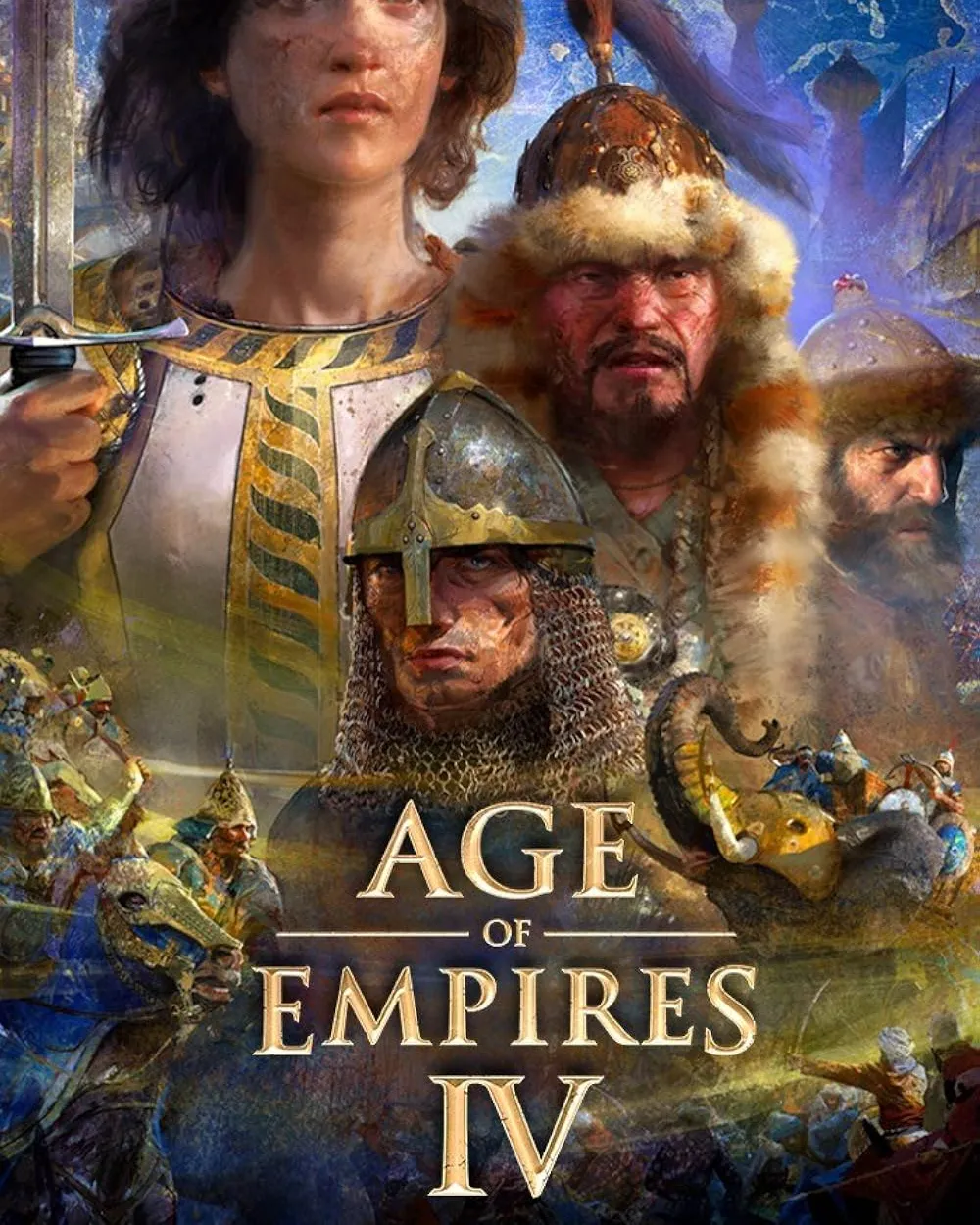
They Killed Joan of Arc: Review of Age of Empires IV
A review of Relic Entertainment's Age of Empires IV: a classic RTS with eight distinct nations, random maps and a careful legacy of the series, but released unfinished — with bugs, a meager single-player part and lazy AI.
Age of Empires is an important game series. In the nineties, on a par with Command and Conquer and WarCraft, it defined the development of the RTS genre.
“Age of Empires” became my pass into the world of gaming. Oh, how many hours I spent on endless skirmish battles and attempts to clear yet another mission. AoE II went with me through my whole conscious life and was invariably installed on every machine.
Fog of War
I was never an active multiplayer player. Competing with bots alongside friends was my pro gaming. This review is dedicated to players like me — ordinary enthusiasts who from time to time indulge in memories of the genre's former grandeur. But I suspect the multiplayer community is still alive, read about that too.
Worry did not leave me from the announcement of AoE IV right up to release. Relic Entertainment was entrusted with continuing the glorious dynasty. I do not belittle their achievements in the least, but their whole portfolio divides into 2 stages: before Warhammer 40k Dawn of War and after. The studio's games that came out after DoW leaned on the “frame” of the Space Marine firstborn.
We exhale — there is no need to fight over supply points. We are dealing with a fairly classic RTS. The gameplay has carefully preserved the whole legacy of the series: we create peasants, enrich the treasury with four resources and wisely invest them in military might and various upgrades.
The choice of nations is so far small — only 8 peoples. Probably in the future this list will be replenished, as we see in the example of the series' remasters. But the sides of the conflict now have far more differences.
- Thus the Mongols do not think about the population limit (it is maximum right away) and can move their whole base to the other end of the map in a moment
- The gentlemen of the Delhi Sultanate get upgrades for free thanks to scholars
- The Rus, meanwhile, get gold for hunting wild animals, because of which in the early stages of the game it is hard to resist the temptation to send your spearmen on a crusade against deer and wolves
Combat follows the classic “rock-paper-scissors” rules. Cavalry deftly breaks through the ranks of archers, archers shower infantry and so on.
The victory conditions are preserved — the AoE series always cared not only for lovers of zerg rushes but also gave a chance to builders of impregnable defenses. So besides completely wiping out the enemy's forces, a player is free to build and preserve a wonder or to hold control over all the sacred sites on the map.
Maps are generated randomly, according to one of the preset biomes. A generation you like can be remembered by number and played again.
The generator itself can play with relief interestingly. In one 2 on 2 match my opponents and I grew walls around ourselves, each preparing for decisive siege maneuvers, until a narrow isthmus among the mountains was discovered. In the end the decisive battle took place on that narrow path.
I like the gameplay, but the problem is… AoE IV has picked up trendy fashions of the games industry: it came out unfinished and with a heap of bugs. The main menu displays a window with a list of daily tasks that bring only experience. The level itself means nothing. Neither do successes in multiplayer, since the ranking system is not ready yet. And this in a game where the online component is presented as the main dish.
The Warrior in the Field
The single-player part is rather meager. The campaigns are fleeting and more resemble a themed Discovery channel game. The missions do not pose challenges to the player and rarely offer unusual situations. It is either a scripted large-scale battle (for a game with a limit of 200 units) or the siege of a fortress.
During the playthrough a narrator's voice reads out historical excerpts. Between missions you can enjoy truly magnificent videos about events of the past or features of everyday life.
The skirmish mode is sabotaged by the local artificial intelligence. I understand, quality AI in strategies is generally a rare thing, but in AoE II they managed somehow! Here… the computer often slacks off, attacks at half strength so as not, God forbid, to break our defense, and also deploys a huge army if it suddenly doubts it can easily sweep away your army. Because of this, after a couple of matches even a convinced offline fan begins to eye the “online” tab.
Exodus
We get an interesting but unpolished product that came out too early. It seems the trend of finishing games after release is becoming the norm. The game has great potential, as evidenced by the lively (within the genre) online presence on Steam and interest from esports players.
I want to believe Relic knows what it is doing and will not abandon its creation. After all, earning recognition from the series' veterans is not a simple task. Whether it will succeed, or everyone will go back to playing AoE II together.
Based on material from ProGamer. Translated from Russian.