The Mountain You Don't Want to Climb: Starfield Review
A critical review of Starfield from Bethesda Game Studios a month after release: the author discusses the monotony of the planets, the weak space sim, loading screens, stealth and technical problems, while noting the best story lines and the polish by the studio's standards.
A month has passed since the release of Starfield. In that time the seething around the new creation of Todd Howard has died down and players have switched to new projects. So we need to answer the question — what was that, anyway?
Bethesda itself loudly declared that the game had been in development for as many as 25 years. Of course, that is not so, since Todd Howard nurtured the idea for 25-plus years, but the company began practical implementation relatively recently.
Only Howard's ambitions and ideas turned out to be beyond his subordinates. No use hiding it — the Creation Engine could practically never be called the best in the industry. For Fallout and The Elder Scrolls it was more or less suitable. But with Starfield problems began — even with all the modifications and improvements.
The task set before Bethesda Game Studios was one of the most ambitious in the game industry. It is extremely hard to combine in one game a shooter, action, a role-playing game, a space sim and a huge number of planets available for exploration.
There is no need to look far for examples. Beyond Good & Evil 2 drowned in development hell. Elite Dangerous never recovered after the terrible release of the Odyssey expansion. And the cult named after Chris Roberts has for the last 10 years been letting itself be strung along, praising Star Citizen videos in which they are offered to pay hundreds and thousands of real dollars for an in-game little ship.
The only exception can be called No Man's Sky. But that game relies entirely on procedurally generated content, and the team of Sean Murray was far from immediately able to polish everything and fulfill all the promises.
And here, against the background of the above, Starfield comes out, offering hundreds of planets to explore, several story lines, space battles, a heap of characters and biomes, a shooter component and much more. However, there are two problems. The first is the aforementioned Creation Engine. The second — Bethesda Game Studios approached the implementation of all the modules the game consists of too superficially.
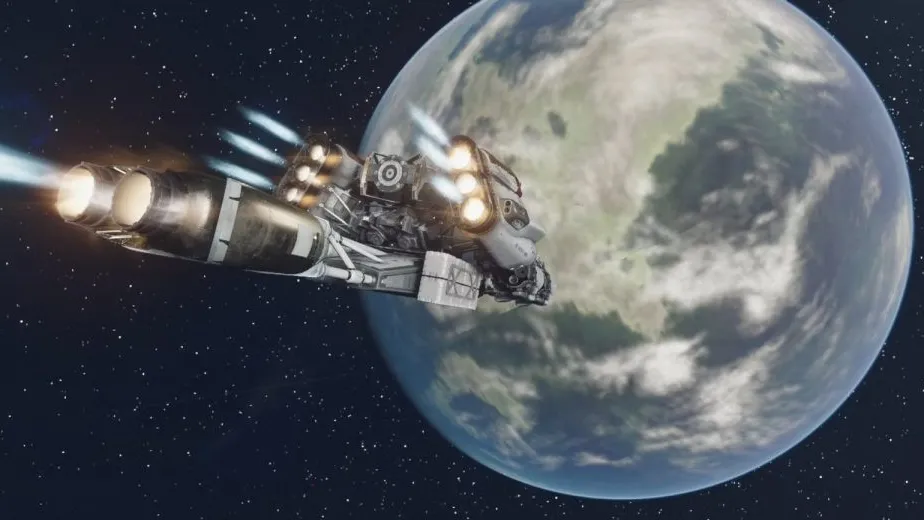
This is best seen in the example of the space sim. Yes, you have a ship serving as a mobile base and a giant backpack. Only nobody will let you properly fly around the Solar System. The maximum you are allowed to do in space is engage in battles with enemy ships, at a small distance from a planet or moon.
Want to get to the surface? Loading screen. Want to fly to another system? Loading screen. There is no open world here at all.
Theoretically you can stubbornly fly for several hours within one system from one planet to another — only to find out that it is a flat sprite. Meanwhile some unique areas for exploration are unavailable. Forget about the chance to fly through asteroid fields or the rings of some Saturn — Bethesda keeps the player at a respectful distance from gas giants, and stars can only be seen on the map.
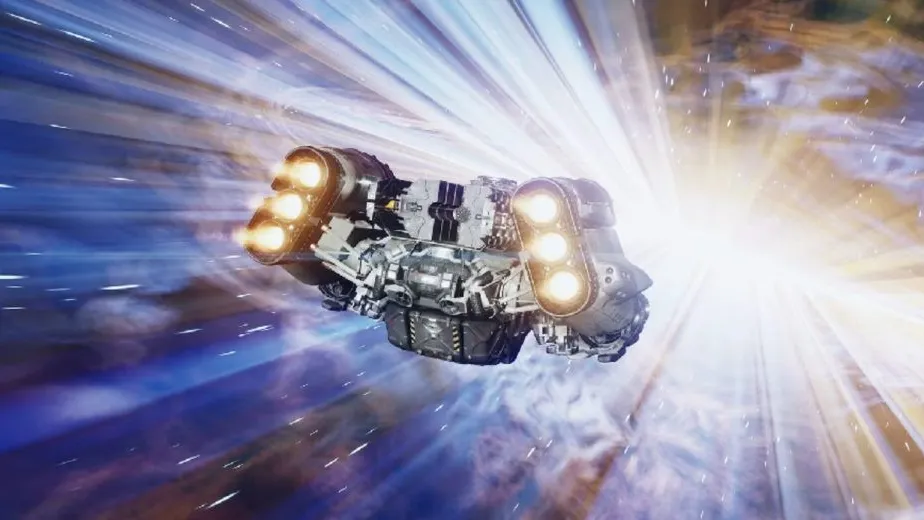
As a result you are deprived of the meditative experience space sims are famous for — flying into the unknown while pondering the mysteries of the creation of the universe. In Starfield you are instead offered to look at a loading screen, because of which hyperjump was replaced with a space-folding effect.
The truth is that Space is a separate module-room in Starfield, which a very remarkable bug clearly demonstrates. At some point my ship began constantly pursuing... an asteroid. Reaching it was impossible because it stays at the same distance. Destroying it did not work either — shots passed through the object. Everything fell into place when it turned out that the rock pursues my character even on planet surfaces.
Modularity in Starfield shows in everything. It is precisely because of this that many players complain the game only opens up after 30 hours. Someone will decide to try to explore all the planets and moons, which are 99% endless empty fields with copy-paste points of interest where absolutely nothing happens. All that is left is to compile a top-10 of rocks and stubbornly clear identical bases where even the placement of crumpled cups is identical.
Meanwhile we have colleagues who are quite satisfied because they hung out exclusively in the capital of the United Colonies and completed the “Vanguard” storyline. In the end both sides are right — one player scolds Starfield for total monotony while another was lucky to find in the heap of Todd Howard's ideas that very “gold”.
Want dynamic firefights in locations that won't repeat? Go to the Rangers of the Freestar Collective! Want to save the world from a terrible threat? The Vanguard recruiting station already awaits you! Dream of plunging into a story about corporate espionage and stealth? “Ryujin Industries” is at your service!
Only the different elements in the game are poorly mixed, on top of which comes the repeated reuse of assets, because of which one can now recall the monotonous dungeons of Oblivion as a model of uniqueness. And a huge number of quests are implemented in the “fetch-and-carry” style or “go to another part of town to talk the right person round”. Talkology here exceeds all reasonable limits, making gameplay suffer. In 90% of cases the player is told rather than shown.
The main story campaign feels worst of all, in which the protagonist wanders around systems in search of pieces of a mysterious object scattered over identical bases on different planets. And it is the story of the “Constellation” faction that is the main reason for talk in the style of “Starfield opens up after 15 hours”. Judging by Xbox achievements, most players abandoned the game around the mission that takes place on the planet Neon. And did not move further, which is a mistake.
With the same approach the player can easily skip the aforementioned “Vanguard” storyline, which is the best, as well as other interesting missions — like a variation on that very mission from Titanfall 2 or the chance to scare tourists in an alien bug costume. In addition, Howard approached the concept of New Game Plus unconventionally, which opens up new story possibilities for players. The trouble is that the idea is also worked out very weakly.
Stealth also fell victim to the superficial approach. In my humble opinion, it doesn't work in the game at all. And what exists looks laughable. Say, the local ventilation shafts are so huge that you can move through them at full height in order to finally find a shortcut into the boss room, which opens... from the boss's side. Yes, a considerable part of the quests does not provide for stealth completion at all, and for leveling skills you are offered to kill crowds of enemies with a silenced pistol.
The object builder can also be scolded. Because of the modular approach, base building falls far short of Fallout 4. And with ships it is very annoying that when building floors the player cannot choose places for the stairs. Instead you have to rely on great random, when you have to climb up in the most inconvenient room for it.
The integrity of the world also raises questions, because it is hard to believe in. This is due to the creators not sticking to a single style, as a result of which the NASA-punk of the United Colonies sits next to the space western of the Freestar Collective. And here, too, superficial implementation spoils everything. The brightest example is the capitals of the factions, which lack suburban zones and stand in the middle of empty fields. And because of constant loading and an overly schematic map of the area it is easy to miss whole locations and shops.
Despite all the limitations, graphically Starfield has been greatly upgraded, but the result turned out very uneven. On the one hand, indoors everything is very beautiful and detailed — down to the model of onions. On the other hand, kilometer-long deserts on the surface induce boredom. At such moments Starfield looks worse than Fallout 76. Believe us — we compared.
The worst situation is with the character models, which in conditions of photorealism often look very ridiculous.
The soundtrack by Inon Zur cannot fix the situation, since no radio is provided, and a considerable part of the compositions sounds as if carried over unchanged from the latest Fallout games.
Starfield can also be called the most polished game in the history of Bethesda Game Studios — and that says a lot. It is enough to recall that Morrowind could stably crash every 15 minutes, and Skyrim is recommended to be played with a bug guide open on a smartphone. However, this doesn't mean that problems don't exist. Characters can get stuck in objects, environment objects hang in the air, sound stutter. At some moments Howard's creation begins to lag and crash, and the lighting system simply turns off.
Bethesda Game Studios's approach, in which the principle of solving problems by the “crap-and-sticks method” dominates, also makes itself felt. Yes, in Starfield underground a chest with an inventory still follows the characters, which in certain situations can be opened with impunity.
Unfortunately, Starfield cannot be called a successful experiment. Todd Howard's team had huge ambitions, only the implementation of what was conceived leaves much to be desired. The output is several gameplay modules sewn to each other with white thread. On top everything is lavishly sprinkled with many-kilometer wastelands generated not by a human but by a soulless AI. Yes, the game is capable of drawing you in for dozens of hours, but because of the uneven distribution of content the lion's share of the audience quickly begins to get bored, abandoning the playthrough.
Defenders of the project may object that fans will solve all the problems through mods. Only that in no way justifies the developers who made a mass of miscalculations.
One can only hope that all of Bethesda's talk about many years of Starfield support will not remain empty bravado.
Based on material from GameMAG. Translated from Russian.