Review of Scarlet Nexus: Empty Cities in the Line of Fire
A review of Scarlet Nexus from Bandai Namco: an action RPG with telekinesis, dynamic combat and Persona-style bonds with companions; the author likes the combat but dislikes the linearity, the static cutscenes, the illogical clichéd plot and the lack of widescreen support.
We have been waiting for Scarlet Nexus for a long time — ever since the surreal trailer in which crazy monsters in high heels and with vases for heads landed on a squad of esper fighters. It was supposed to turn out, at the very least, beautiful and, at most, interesting too. The folks at Bandai Namco usually delight with unconventional ideas. Did it work out this time?
The game's action takes place in an alternate future code-named “brainpunk” (brainpunk — a fitting name for a setting built on the fact that all or almost all people have some kind of psionic abilities). In this world science has finally managed to unlock the full potential of the human brain, so practically all children are born with superpowers: telekinesis, pyrokinesis, telepathy and so on.
Everything seems wonderful, but no. The planet suffers from raids by aggressive mutant monsters falling, quite literally, from the sky, from the Extinction Belt surrounding the Earth. Most of the territory is abandoned and left to the monsters; the remaining population has evacuated to several large cities equipped with shelters and defense systems — and even so the mutants periodically break through. To fight the monsters, named Others, OSF squads (Other Suppression Force) were created, recruiting the most talented psionics. Teenagers, because abilities manifest most actively at a young age. And so that these squads do not have to be renewed every couple of years (because kids grow up), the young soldiers are fed hormones slowing aging, so even at forty-five they look sixteen.
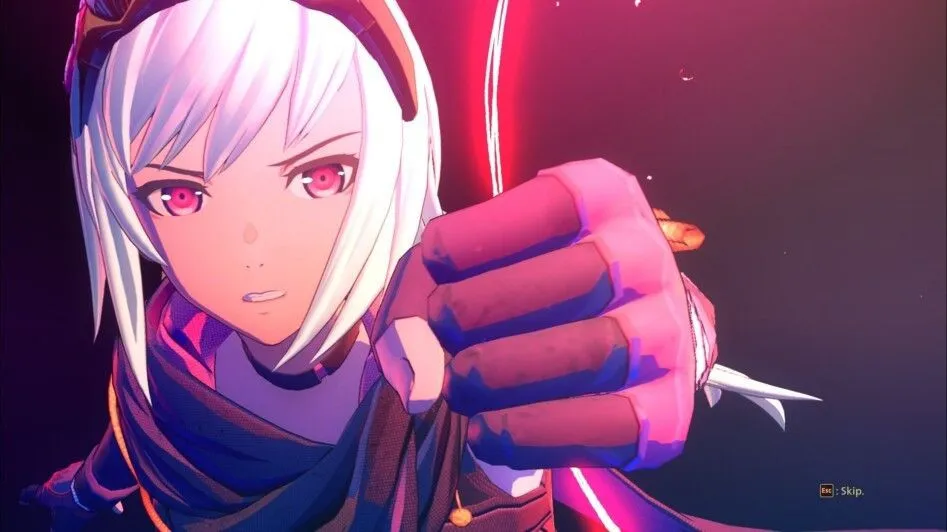
In just such a grim situation we find ourselves — as the main hero, a new OSF cadet. More precisely, one of the cadets, your choice: Yuito Sumeragi, a noble, brave and honest slacker (a classic jRPG protagonist) and Kasane Randall, silent and always serious, thinking only of the well-being of her beloved little sister. Their characters are diametrically opposite, even the weapons the two have are different: Yuito has a sword, Kasane throwing knives. But the special ability is the same — very strong telekinesis, which lets you hurl even cars and chunks of sidewalk at enemies. The game can be played as either Yuito or Kasane, and it is recommended to play both routes to understand the plot completely.
What is wonderful in Scarlet Nexus is the supremely dynamic combat. Wheee! Thanks to the aforementioned telekinesis every fight with a group of enemies (they do not come alone, of course, except bosses) turns into a merry “I kicked your house, pipe and all”. Throw at a monster an uprooted roadside lamp, a rusty passenger car, a bicycle, a chunk of concrete? Easily and with pleasure! When combos become available to us, it all also ends with a gorgeous slow-motion fatality. In the subway we can knock a couple of train cars off the rails and ram a crowd of mutants with them, on the highway — jump onto a truck, perform a spectacular flip with it and bring the vehicle down at full speed on the monsters in the way. Magnificent, stunning in every sense, only here, many, many times! And while the psionic energy gauge recovers you can kick the enemy with an ordinary weapon, which is no less pleasant.
Naturally, Yuito and Kasane do not fight alone — squad mates run with them, adding vigor to the fights. By default they just kick monsters, playing the role of a support squad; but at the press of a single button the MC and any of the partners can “combine” forces. So we get, depending on the party members, many short-term buffs: super speed, teleportation right to the enemy, electric or fire damage, the ability to see in fog, invisibility… Naturally, you have to keep track of all these effects, because they expire fairly quickly (and, if you have not taken the special skills, you cannot activate more than one synchronously), but while they last fighting is a pure joy.
Special skills? Yes, this is about the Brain Map, the RPG part of Scarlet Nexus. The points that come after leveling up have to go somewhere! Especially considering that there are skills there that are literally vitally necessary, like a double jump (where would an action RPG be without a double jump?), an air dodge and an increase of the psionic energy gauge. So as you advance through the story the MC levels up accordingly, and the fights become even (though how much further can they go?) more dynamic and interesting.
In general, running around and killing enemies here is fun, no question. If only it all happened in an open world or at least there were a chance to alternate locations more or less freely! (After all, the developers created many beautiful areas — both the starting city and numerous abandoned construction sites and settlements, and… well, I will not spoil.) We simply move along a path straight as a first-grader's ruler, not deviating a step. And there are practically no side quests, and those that exist are shameful to even count as quests — “kill two mobs in a jump”, “bring me three items”, they are turned in by pressing a button in the quest menu, without even reaching the NPC.
But there are Bonding Episodes! Those who played Persona 3-5 already understand what this is about. Relationships with party members are leveled by fairly frequent use of SAS Link (that very “combining of forces”) and, of course, by presenting gifts in the hideout. You can give the same gift twenty times and not worry — friends are not picky! Raise enough and you get an episode during which there will be a heart-to-heart talk in a café, an outdoor adventure or something else with the chosen character. At the same time you do not need to choose what to give, and there is no need to think about what to say during the episodes themselves — everything is linear. Raising the Bond Level gives significant advantages in combat. And some swappable outfits or bonuses to outfits, which is also a plus. And the gifts given are later displayed in the hideout-“house”, turning a faceless bunker with a minimum of furniture into a cozy living room.
(There are, true, no romances as in Persona in Scarlet Nexus. At most, light flirting.)
So what do we get? Spectacular surroundings, good combat, partners. Linearity, well, never mind, we will look for open worlds in other games. Everything seems ideal, but not quite. The main complaint about Scarlet Nexus is the plot. One could ignore it (I truly hate doing that), but it does not work.
We are not allowed to run and kick Lovecraftian-mad little beasts to our heart's content on the ruins of cities, as in Nier Automata. We ran a hundred meters — a cutscene (and not in motion but static, as in visual novels; dialogue — and pictures), another fifty — another cutscene. Usually I am for the story with all paws and tail, the story in an RPG is the main driving force, but in Scarlet Nexus it is rather that force that wants evil and does… hm, some kind of heresy, frankly. And along the way it grabs us, that is the MC, by the scruff like a kitten and drags us through the story, not letting us collect ourselves and look back.
There are no dialogue choices at all in the game, even ones consisting of “yes”, “of course” and “as you say” (and this in an RPG! I had just played Digimon Story Cyber Sleuth from the same Bandai Namco, and there there are a hundred times more quests and a million dialogues with choices…). The characters consist of anime clichés slightly more than entirely; once you have seen a character, you know them completely, do not worry, no hidden depths are planned. Thanks to classic anime moves you can already in the first five minutes of the game predict who will die soon and why. The writers tried to cut loose on the story, stuffing in the maximum number of “whoa-what-a-twists”, and as a result got a mix of cheesecake with vinaigrette: we are constantly told “and here is how it is! you did not expect that!”, and in the end the player gets tired fairly quickly of the considerable illogicality of what is going on. If the plot had been limited to the grim confrontation of psionics of the future and mad mutants on a planet standing on the brink of destruction, honestly, it would have been a much more cohesive and worthy work. As it is, they just did not add space unicorn pirates as a bonus.
As a result we get half an hour of pleasant gameplay — and then a looong cutscene with a detailed breakdown of “what is going on, and why everything is not as it seems”. Nothing seems to the player anymore, and what the player wants is coffee and for everyone finally to stop giving history lectures and let us beat up monsters some more.
On the other hand, everything except the plot in the game is up to par. And as for the plot — an anime based on the game is coming out right now; maybe it will be clearer and less tedious there.
P.S. Personally I have one more purely-PC complaint: the lack of built-in widescreen and ultra-widescreen support. It is clear that Japanese developers consider wide screens heresy and demonic scheming, and that modders from nexus will sooner or later find a way to shove the game into the needed resolutions, but how long can this go on?
Based on material from ProGamer. Translated from Russian.