Polymerization and Pies: Atomic Heart Review
A review of Atomic Heart: the author notes the strong setting, the music and licensed soundtrack, the slow pace of combat and the inexpressive voice of Nechaev, but criticizes the shaky story, the technical errors and the drawn-out dialogues.
Fortune favors the bold. Courage is also the eternal companion of progress. Science simply cannot exist without bravery, since every step forward, even one perhaps doomed to failure, requires considerable resolve.
In essence, these lines can describe both Atomic Heart as a whole and the ambitions of the Mundfish team — large-scale, loud and rightly mad.
In the unprecedented fantastical history of the last century the Union of Soviet Socialist Republics defeats Germany, but the enemy, unwilling to surrender, unleashes a deadliest biological weapon — a plague fated to take the lives of millions of people. Against the backdrop of this tragedy the USSR begins to invest actively in robotics, and at that same time comes the rapid career rise of Academician Dmitry Sergeyevich Sechenov — a brilliant scientist sincerely wishing to bring humanity to the next turn of evolutionary development.
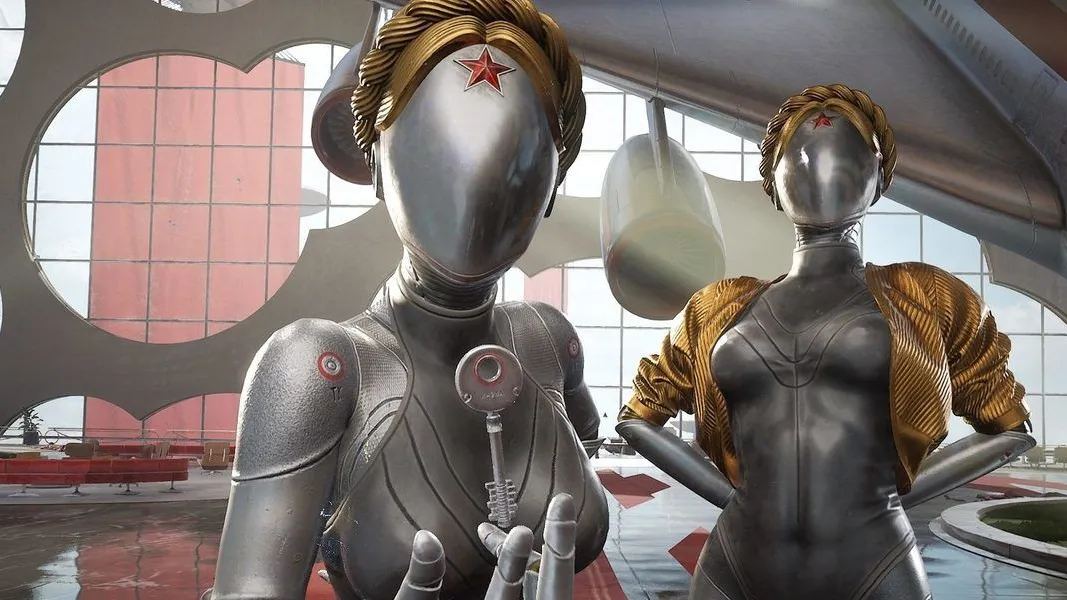
The new industrial revolution lets the country make a real breakthrough. New technologies are integrated everywhere into people's lives, including a variety of Soviet machines. Loaders, helper bots, aircraft and much more. The robots, meanwhile, impress not only with the complexity of their mechanisms but also with outstanding intelligence — the iron friends can hold a conversation or give a tour.
Academician Sechenov, in turn, runs even further ahead — the researcher is preparing to launch the “Collective 2.0” program, in effect a model of a gigantic collective consciousness in which each participant has access to a boundless treasury of knowledge and can freely express their opinion on any question, together steering the Earth toward the brightest future.
Here Major Sergei Nechaev, also known as Agent P-3, takes the stage. A military veteran and a confidant of Sechenov, the hero sets out on a routine mission — he is going to oversee the smooth launch of “Collective 2.0”. But fate has completely different plans, and the combat potential of the Soviet super-soldier undergoes the severest test.
Unexpectedly for everyone, the robots populating the research complex “Facility 3826” literally go mad. The once kind machines drop the mask of courtesy and begin to systematically grind up all the organic matter that comes to hand — the roads are strewn with corpses, someone's entrails, bullet holes and blazing fire.
Observing the chaos unfolding, Sechenov instructs P-3 to get to the bottom of what happened — to prevent the catastrophe and punish the guilty. The faster the better.
Even in an alternate history there is hardly a better tool for solving such problems than good firearms. If the robots do not want to be friends, that means they must be shot. Quickly and painfully. Just like in the numerous spirited trailers that accompanied Atomic Heart to its final release.
But you should not be fooled by the trailers. Atomic Heart is a game of rather low dynamics. A shooter, yes. But the “run and gun” principle almost never works here, especially in the first half of the story campaign. It is not like DOOM, and some Bulletstorm was about something completely different.
Mundfish's debut project bets on other things. The first item in your arsenal is an ordinary axe. With it you can make wide swings, smashing the casing of the mustachioed Vovchik robots. The robots do not want to stay in debt either, so they hit back — you have to dodge. So at first the game teaches you to find the right tempo — make several attacks and retreat into defense, repeating until a swift victory.
Once you learn to swing the axe, Atomic Heart gives you a powerful shotgun, inviting you along the way into the gloomy corridors of the “Vavilov” complex. It is beautiful here and even a little scary. Perhaps because there is very little ammunition for the shotgun — you have to alternate the gun with the already familiar sharp blade on a stick. You get the feeling of ending up in a game of an entirely different genre spectrum. As though you are not a hunter but a victim, as in some old part of Resident Evil. The comparison may seem strange, but only until you come across a cozy save room with soft ambient music where a storage chest is conveniently placed, and from the nearest room Beethoven's “Moonlight Sonata” begins to sound solemnly and grimly.
However, the game will not mark time in one place for long. Now shooting at robots is no longer especially scary — there is a bit more ammo, and two new guns have appeared in the inventory. What is more, the futuristic glove on Nechaev's hand begins to emit tension — dangerous lightning can be hurled at enemies. Resources still do not suffice for the variety of enemies, so you will keep changing tactics — combining melee and ranged combat, stinging Vovchiks with current, retreating and attacking again, gracefully dodging especially powerful lunges from opponents along the way.
You begin to understand that Atomic Heart is a game of positioning. Robots are not people, you will not topple a machine with a single accurate hit. Before shooting it is better to think, shoot and think hard again, because your attacking options gradually become more and more numerous. Including access to energy weaponry whose charges are restored by melee attacks. This spurs you toward a natural rotation of weapons.
Along with the progression of the combat system, the skeleton of the overall game structure gradually develops too. The opening section at “Vavilov” is a strictly linear level, but quite packed. Here and there designers invite you to visit optional rooms to explore — they hold resources, notes and audio diaries that add context to the unfolding events. Sometimes a location may offer a tiny but pleasant fork, trusting you to choose the optimal approach yourself.
Some of the doors are blocked by locks. Some of them open only after you turn the gamepad stick in the right direction, while some ask you to solve a modest reaction puzzle or to correctly match up several lights.
There are bigger puzzles too — these are already integrated into key elements of locations. The most popular is tied to synchronizing colored beams, where you need to rotate several discs so that the laser threads connect to one another in a suitable way. There is something more interesting too, such as situations where you can manipulate entire elements of the interior, but it is best not to spoil all the surprises here.
After a couple of hours the illusion of a perfect idyll slowly but surely forms. You have gotten used to the game, it has gotten used to you, and nothing can spoil the celebration now. Alas, illusions have a way of dissipating. Sooner or later you climb back out into the light of day from the cold guts of the science stations, where the grass is green and bees fly. It turns out that Atomic Heart has wide open spaces. Not an open world — that is, after all, a term of substantial weight — but precisely open spaces: large locations allowing the player to deviate from a pre-prepared rigid course.
These locations are easiest to describe as a kind of hub zones. Stretches linking the key points of interest where the main events unfold. The hubs themselves are spacious — you can even drive the little cars scattered in the corners, first of all to save time. And nerves.
And all because in the open sections the authors from Mundfish coldly and unceremoniously decided to introduce us to yet another of their crazy ideas — the concept of a mechanical ecosystem, where the game diligently simulates a most complex artificial-intelligence system designed to destroy any villain efficiently.
In practice this means robots will come for you, and in large numbers. They come not at once but only after you end up in the lens of one of the many security cameras. Mechanical eyes carefully scan the territory, wishing to witness your misdeeds. If the cameras manage this mission, the game raises a conditional alarm level, after which all the synthetic fauna rushes to your position without delay. Having grown completely insolent, the game may even start dropping robots right on your head — they are brought in special crates from which inevitable doom soon pours in a single stream.
Sounds interesting. Even moderately engaging. But remember that Agent P-3 is as vulnerable as ever, the robots are resilient, and the ammunition is limited. And while in corridors enemies may be outwitted, dismantled and destroyed, an army of endlessly respawning scrap iron cannot be beaten. Moreover, there is no need to. Resources can be harvested from the defeated, which are later spent on developing the hero, but you will have an abundance of them anyway. This creates an unpleasant situation where the most advantageous behavior outside closed locations is simply skipping them quickly — you will tire of shooting enemies far sooner than they run out.
In fairness, it is possible after all to compensate for your missing advantage over the army of metal. Special stations hover in the skies, and switching them off temporarily disables the combat machines, and the game finally gives you a breather. But whether you will want to spend your time on these complicated manipulations instead of simply slipping back into the quarters of the quiet underground and the designer-curated gameplay is a big question.
Optional complexes are also scattered across the hub zones. Separate levels consisting of a set of harder puzzles. For clearing them you will unlock special blueprints for further equipment upgrades, which happen with the help of overly amorous vending machines.
The leveling is standard. Both the hero's basic stats, such as movement speed and health pool, and the active skills of the glove, which gradually learns telekinesis, freezing and a couple of other tricks, are improved. The weapons stand apart — a dozen guns can be tuned precisely, changing not only their looks but also their characteristics. Attachments, sights, extended magazines — even the little PM pistol has the potential to turn into a hole-burning blaster.
Good equipment is the key to victory, which is felt most strongly during boss fights. Yep, Atomic Heart has bosses. There are few, but each fight is definitely memorable, because the opponents use atypical behavior patterns, have unique attacks and try to surprise with a visual riot, jumping and flying across the whole available area of the arenas.
There is only one complaint about the bosses, but a serious one — the developers' sense of proportion failed them, especially regarding their durability. Continuing the trend set by ordinary opponents, bosses too can soak up dozens, hundreds of hits. You will have time to memorize every animation frame of every attack, while the shell on legs is still merrily dancing before your nose — you only have time to send a fresh batch of rockets into it.
Sometimes quite sloppy situations occur where the game may spontaneously lock you in an arena with a boss vulnerable only to a specific type of attack. If it turns out you do not have the needed weapon with you, two alternatives remain. Either you mechanically bite tiny pieces off the enemy's health bar, thereby stretching the fight by a dozen extra minutes, or you simply reload the checkpoint and walk back to the chest for the right combination of items, while P-3 once again drones through some empty monologue.
Naturally, a lucky chance may come along, and the monologue will turn out not empty but interesting. And if you are really lucky, the monologue turns into a dialogue — the smart glove Charles answers the hero, and the characters together tell you something curious. But this does not happen often.
Atomic Heart in general is deathly afraid of silence. Whether you run or climb, shoot or hack, fall or soar — Major Nechaev will certainly comment on the situation. On any plane and in any state. The comments will be fitting, unfitting, ridiculous, absurd, funny, pointless, witty. One thing is constant — there will be comments. About polymerization, pies, communism, artificial intelligence, and only the Party knows what else.
Unfortunately, Nechaev's talk is also tiring because the hero's voice acting is quite inexpressive. The character is drawn approachable and understandable — a competent lunk with a heart of gold, rough outside but kind inside. The actor who lent P-3 their voice does acceptable work, but the picture still does not come together, because the major mostly simply has nothing to say, and the abundance of swearing comes across not as something biting and rowdy but as banal vulgarity.
One can get confused and decide that all the voice acting in Atomic Heart is of an unremarkable level, but when you pick up a random audio diary, the colors burst into other shades — convincing and clear voices unexpectedly start speaking in your headphones, which are not only pleasant but entertaining to listen to.
Then, true, the focus returns to Nechaev anyway, outraged for the tenth time at the outrageous behavior of outrageously disobedient robots. Having come out to the outskirts of the town of Ravenholm screaming in agony, the physicist Gordon Freeman did not utter a word. And what an effect it had.
More is not always better. Which is especially relevant in Atomic Heart, where the sets for the most part have enough character to establish a connection with the player without any outside noise. No longer sterile laboratories drowning in cold light, they can tell their story even without clumsy dialogues. The Stalinist megastructures convey the mood chosen by the artists superbly. Every screw, bolt and color of the machines' casing — everything in its place, everything coherent and to the point.
The overall expressiveness of the setting is perhaps the single greatest plus of the entire project. Whether you examine it at the macro or micro level makes no difference, you can be impressed either way. Having gotten used to the atmospheric environment, you will notice that even the outer paraphernalia is somehow fitted into the context of the world invented by the writers. Technologies do not come out of nowhere, all sorts of conventions, like P-3's almost bottomless backpack, are as much a part of the mosaic as the railgun charging in your hands.
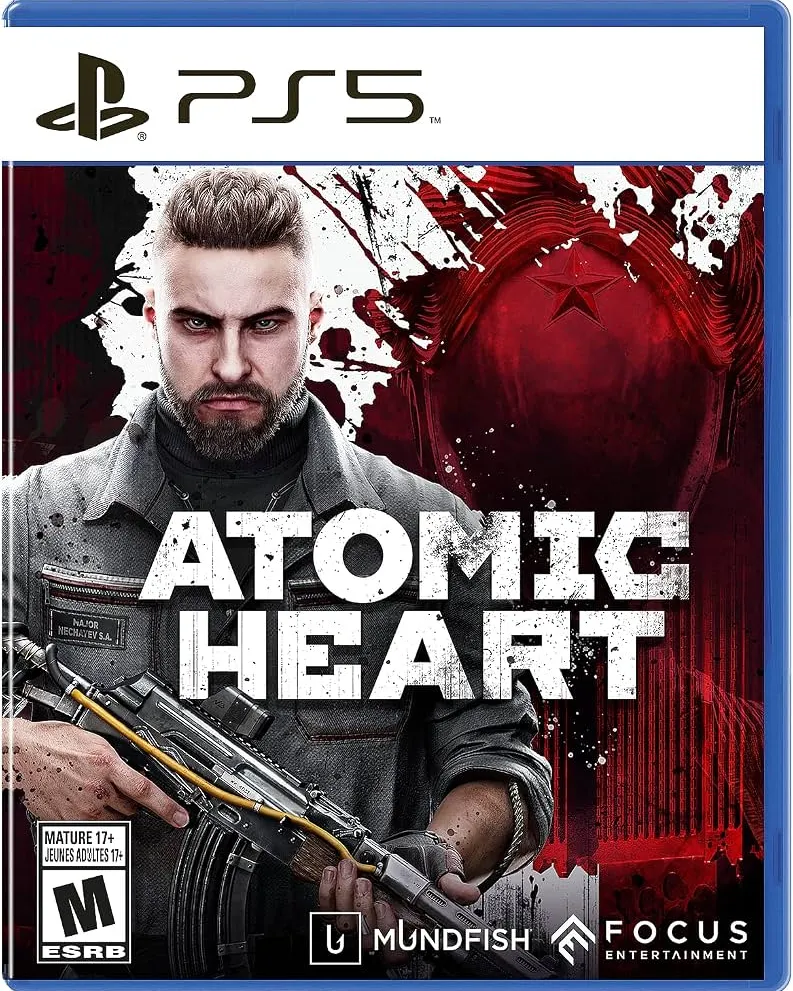
A noticeable outward exception to the rules is perhaps only the main characters. Namely Nechaev himself, as though stepped off the cover of a faceless and forgotten game from the end of the decade before last, as well as the ordinary Soviet neurosurgeon Larisa Filatova with a shaved nape and violet and blue hair.
The music gives the game even more identity. There is a lot of it. It is good. It is always apt. The original soundtrack turned out suitably varied. There was room both for soft electronic compositions, one of which evokes very strong associations with the modern Deus Ex duology, and for angry combat themes where percussion parts push you to the edge of your chair or sofa, setting the rhythm of yet another dance of death.
The peak for many players will, of course, be the work done by the composer Mick Gordon, who immortalized himself in the pantheon of legendary game musicians with his albums made for DOOM, Wolfenstein and Killer Instinct. In Atomic Heart his handwriting is recognizable from the first notes — the screech of frenzied electronic guitars still turns your insides out, penetrating through the ear canals into the very soul. Fans will like it.
But my personal musical favorites were the numerous licensed compositions. Everyone liked the cutscenes set to “Mirage” and Alla Borisovna Pugacheva so much that the Mundfish developers bought a seemingly endless selection of music for the final release. From classical pieces to Soviet hits and completely unexpected guests such as Viktor Tsoi, “Ty ne ver slezam” by Shura (!) and hits by Valery Meladze. What do they all have to do with the alternative fantasy sixties? The most direct thing! But you will be told about this in the game itself.
To let the fantasy breathe fully, the authors also prepared a variety of diaries scattered across different parts of “Facility 3826”. Their own tragedies and comedies unfold in them, small adventures and dramas, whole storylines that you have to piece together yourself, without the help of talking heads — it is interesting.
It is only a pity that the writers failed to carry over such a successfully selective approach to the main storyline, which toward the finale finally defines itself as a stale shapeless jelly from a factory canteen.
Perhaps the trouble is that the writing side of Atomic Heart has trouble deciding on the desired poles.
Half the time the game unashamedly borders on absolute farce, resembling a shameless comedy. Not the funniest, but still able to pull you into the kitsch of the unfolding farce. Granny Zina fires a flare gun at a robot and swears a blue streak. All clear.
But then something clicks, and you are required to concentrate fully. The safety of the whole world is at stake. Moral and ethical dilemmas about the role of morality on the rails of unbreakable progress. Somewhere conspiracies are being woven, no one can be trusted, and every word spoken or careless action necessarily entails irreversible consequences.
In some works of this kind tonal leaps are justified. Some authors even manage to weave them into the artistic style, abruptly pulling the rug out from under an unsuspecting audience. For shock, emotional resonance or just for a joke.
Mundfish did not manage anything of the sort. The game sterilely delivers an inexpressive storyline through rare cutscenes and, as already mentioned above, frequent dialogues. The developers fail to create the proper intrigue or sense of alarm, so by about the middle of the playthrough Nechaev's companion, the glove Charles, begins to tell the hero, and consequently the player, in plain text what thoughts they should think. Room for nuance remains, but it has nowhere left to go, because the credits are creeping up on the screen.
Toward the end of the playthrough the writers apparently tire out completely, and about forty minutes of dry exposition are poured onto you from above. With a heap on top. Accessibly explaining who, where, why and wherefore. Of course, by means of dialogues, literally locking you in a room, letting the characters speak out all the lines written for you.
Within the natural course of play, however, it is not always possible to listen calmly to conversations, even the most important ones. In the game there is generally a somewhat strange job of mixing and layering sound, including dialogue. Very often it happens that characters start talking among themselves, and any wrong action of yours can put a fat full stop on it. Accidentally ran into enemies? The dialogue is interrupted. Stepped over the threshold of an “important” room? The characters forget the old conversation and start a new one. You cannot hear it out or hear it again — there are still many things to discuss.
The balance of the tracks to one another also often fails. Dialogues, on average, sound much quieter than the environment, and during certain sections noisy music is added to the scene as well, making it impossible to make out the words spoken by the heroes — only cacophony is audible.
The latter can probably be put on the list of technical errors that the developers have yet to fix. In the press version, played on PlayStation 5, there were plenty. Over 13 hours of gameplay the game managed to “crash” about ten times, half of the cases falling on one particular segment. Meanwhile, toward the end of the playthrough the concentration of bugs only increased. I ran into incorrectly played sounds literally turning into unbearable crackle and grating, interface errors, a non-working map, items vanishing from the inventory, disabled enemy intelligence and Atomic Heart's reluctance to register gamepad presses.
The game can, of course, be completed even with all this, but the errors deserve mention. Taking into account that the production of Atomic Heart fell on the pandemic-forced remote working mode, and optimization was done simultaneously for seven console systems and PC, there remains hope for post-release updates.
With performance everything is far simpler on the whole. The console versions of Atomic Heart do not offer different modes and launch with the single available settings. The PlayStation 5 version runs at sixty frames per second and does not suffer from drops. Everything loads fast too. I will not write about rendering resolution — it is better to wait for analysis from specialists.
As the result of a bold exploration, Atomic Heart is a wonderful and somewhat uneven thing. Bright, expressive and imperfect. The experiment may not have become a breakthrough, but a brave attempt is definitely worth noting. And the experience gained is simply priceless — sooner or later the granite of science will surely yield. Though not this time.
Based on material from GameMAG. Translated from Russian.