Pathfinder Wrath of the Righteous Review: Fighter, Cleric, Mage, Rogue and a Fox on a Dinosaur
A review of Pathfinder: Wrath of the Righteous: the author is delighted with Owlcat's classic isometric RPG — its classes, races, companions, branching story and Mythic Path — but criticizes the crusade's strategy mode and the bugs, and calls the game the RPG of the year.
A classic RPG from the Russian studio Owlcat. The sequel to the much-talked-about Pathfinder: Kingmaker. A branching story with many endings; tactical battles; a “strategy” mode that lets you command huge armies; the chance to play as a half-vampire, half-djinn and half-angel; choices, each of which matters for the plot… Empty promises? Surprisingly — no. Everything listed above is the plain truth. Pathfinder: Wrath of the Righteous really is wonderful, delivers in full measure everything that was announced and hooks you for a long time. One hundred and thirty hours on Steam — and after one ending you want to replay again and again, to try different variants, builds and puzzle solutions.
As Gavin Dunne, aka Miracle of Sound, sings:
[Lyrics omitted:
the song is about the effort of writing a vast RPG
with reactivity
and real consequences.]
Any good RPG starts with the “create a character” mini-game. So, WotR has a multitude of creation options. 25 classes — and those are only the base ones, each also has subclasses with their own specifics. You can make someone as unique as the Urban Hunter (a hunter specializing in catching criminals, with a pet dog) or the Stigmatized Witch (a witch whose gift is not a talent but a curse, suffering from some physical ailment). Plus thirteen prestige classes, which require leveling certain skills and abilities. Plus what is called the “choice of a Mythic Path” — this option opens up gradually during the playthrough, granting many unique skills.
Many of the classes can choose familiars for themselves (want originality? there is a centipede familiar and a lizard familiar). Some also get a pet that will fight side by side with its master. You can take a wolf, a dog, a horse for riding. You can take a triceratops or a velociraptor. Yes, there are dinosaurs here! And beautiful prehistoric beasts — for example the smilodon and the mammoth. A full magnificent zoo!
There are many races too. From the familiar human-half-elf-dwarf to the more unusual aasimars, tieflings and kitsune. Aasimars are people with angel blood, golden-haired and golden-eyed. Tieflings, on the contrary, are the bearers of a demonic heritage, with horns and a tail. And kitsune, as is easy to guess, are foxes! Shapeshifting foxes walking on two hind legs, also with a tail (but a fluffy one), able at will to turn into full-fledged humans.
Seriously, in Pathfinder WotR you can play as a little fox! Even better — you can play as a little fox riding a dinosaur!
What else is needed to buy the game immediately? In my opinion that is everything you need to know. End of review, full stop.
Fine, let it be a comma. Because there are still many wonderful “features” in the game.
For example, companions. There are many of them, more than a dozen, and each has their own story, their own long personal quest. Each of them joins the protagonist for the sake of some goals of their own. The researcher Nenio, who wants to compile an encyclopedia of everything on Golarion; the young and slightly mad witch Ember, who has already managed to be burned at the stake; the refined aristocrat-healer Daeran; the carefree tiefling thief Woljif; the intelligent talking bracer-weapon Finnean, who considers himself a human…
A motley company is gathering. And a very talkative one — each of them always has something to say about the surrounding madness or an unfinished task.
At rest stops these folks discuss the weather, trade barbs, cheer one another up. Ember cooks food, Daeran tosses Nenio ideas for experiments, the repentant succubus Arueshalae prays at night, the dwarf assassin Greybor prepares to stand watch.
Naturally they all have different alignments — from lawful good to chaotic evil, the full set. And not all will agree with your “choice of path” (remember Baldur’s Gate 2 and the friction between party members — for example Viconia and Aerie?). But with proper diplomacy many will stay with you to the end. My favorite companion, for example, turned out to be the Lawful Evil gnome Regill, a Hellknight by profession, such a classic warrior-inquisitor who values discipline and the destruction of demons above all. Regill is surprised by practically nothing, knows firmly what he wants, and seeks no excuses for himself or anyone else.
Who asked about romances? There are romances! Of any gender, to every taste.
The plot is at first deceptively simple: the action takes place on the fantasy planet Golarion, not far from the so-called Worldwound, a huge magical rift in the ground. The Worldwound, a breach in reality between worlds, appeared more than a hundred years ago, burying the kingdom of Sarkoris beneath it. Near the rift reality begins to change strangely — bloody rains fall, beasts mutate, transparent crystals grow from the ground. And, most importantly, this breach leads to the Abyss, to the lair of demons. Naturally, over a hundred years the visitors from the Abyss, merciless and bloodthirsty, have flooded the plain.
The main state opposing the demons is Mendev. The queen of Mendev, the goddess-blessed warrior beauty Galfrey, has already led four Crusades against the demons, but each of them ended in failure: the enemies were stronger. But while the cities of Mendev are guarded by the Ward Stones, another gift of the goddess, the inhabitants can sleep soundly — the demons will not set foot on the doorstep. Or will they?..
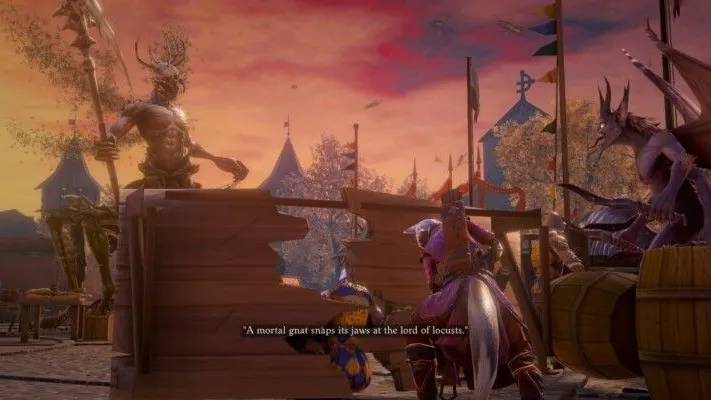
So, the time of action — a century and a bit after the Worldwound arose, the place — the border city of Kenabres. A festival, a fair, you can join the revelers, drink beer, gawk at performances. But in the midst of the entertainment the demon lord Deskari, resembling a humanoid locust, falls from the sky (literally). With one blow of a huge scythe he beheads the silver dragoness Terendelev, the city's defender.
A gang of demons in a matter of minutes turns Kenabres into burning ruins. A crazy hopeless fight, an escape, a headlong fall into a chasm beneath the city, a search for other survivors, an attempt to scrape together a resistance and unite in order to see the next dawn… By the end of the game's first act our bewildered hero finds themselves at the head of a new Crusade — the fifth one.
No, this story will not be the basic “we are good, they are bad, in an organized crowd of immaculate white cloaks we go to whack evil”. You can, of course, play out the situation that way — but it is only one of the options. We learn the causes of the Wound's origin, the history of the fallen kingdom of Sarkoris, talk with demons and with angels, and make many choices.
And in the end, of course, we will finish the Crusade successfully… but there is a heap of different ways of doing it. And some of them are not good at all, quite the opposite.
Unfortunately for me, I did not play the previous game in the series, Pathfinder: Kingmaker (must do!). But judging by the screenshots, the game has not changed much on the outside. There are graphics improvements, and you can freely rotate the camera. Visually WotR is a classic isometric RPG reminiscent of Baldur’s Gate and Pillars of Eternity.
The combat system is also classic, familiar from BG. Real-time with pause. But that is not all: in WotR you can switch to a fully turn-based, round-by-round mode similar to the system of Divinity Original Sin. If real-time combat is too fast, hectic and unmanageable for you — then slow turn-based fighting will be your choice! To me, small enemies are easier to handle in real time, while more serious bosses can be taken calmly and at a measured pace, thinking through every moment.
The game is based on the rules of the Pathfinder tabletop game, so dice are responsible for skill checks both in combat and outside it. Virtual ones, of course. Sometimes this is irritating (critical misses come with it if you roll a one), you want a more stable system, but the “rolls” have their upsides too.
Dice add excitement, the possibility of luck and misfortune in a fight. By the end the necessary skills will be sky-high anyway, so you will get the chance to “pass a check with a result of 101%”.
The game is huge. Even at the very beginning you can be overwhelmed by the abundance of locations — and in the first act only the city of Kenabres is available to us! Starting from the second act of the game we crawl out beyond the city walls — and see a boundless world. A heap of places, a heap of quests, some strategic points have to be recaptured from the demons first. All places are unique and recognizable at first glance: forests in the north, cracked rocks in the south.
Closer to the Wound bloody rain really does fall often — not dangerous, but making you quite nervous. The ruins of Sarkoris are protected by metal doors and dangerous traps; a trade caravan run by a living skeleton travels across the wastelands; the small town of Wintersun, lost in the thickets, harbors practically Lovecraftian madness.
And when we reach the very chasm into the Abyss and step inside… Wow!
WotR has many difficulty options, and you can tune any aspect of the game to your liking. Enemy AI, damage dealt, the frequency and strength of critical hits. You can set companions and even your own character to auto-leveling, if you are too lazy to pick features and skills yourself. (But why? That is the most interesting part!).
For the laziest there is the Story difficulty, where almost all enemies are “click-killed” automatically, and for the most stubborn the Last Azlanti mode with a single save — die and you lose. So the game can be enjoyed both by seasoned veterans and by green newcomers.
Let us talk about the mysterious Mythic Path. Our hero ends up the head of the Crusade not least because of possessing strange talents: either divine or devilish, no one knows for sure. Only the hero will be able to understand what they want from life and choose their road. And each choice in turn will change them.
You can refuse all powers, acknowledging yourself as mortal and one of the many, a human capable of defeating the supernatural. That is also one of the paths.
What do you want — to preserve the world's harmony? To change the laws of logic and common sense with a smirk? To cast off the shackles of fragile flesh and become a lord of the undead? Welcome to WotR.
And have you ever, by chance, wanted to play as a sentient and eternally hungry swarm of insects? Never mind, never mind, I just asked.
Perhaps the only thing I did not much like while playing is the mechanics of the crusade itself. Besides our company, armies also move around the map — both ours and allied — and our task, as the crusade's leader, is to win a strategic victory.
Nine out of ten Russian-speaking gamers (especially those who are older) know and dearly love the third Heroes, that is, Heroes of Might and Magic 3. It is no wonder that Owlcat decided, instead of the kingdom management that was in the previous game, to dilute the RPG with a likeness of those very Heroes. There are units gradually accumulating in cities, which can be gathered into armies. Hire generals for an army — and go rob caravans, I mean crush enemy armies and checkpoints.
Your own city can also be leveled up — build all sorts of barracks, towers and inns there. The most useful building is the teleport circle, which lets you instantly return to the capital from any point on the map; a little later it becomes possible to place such circles in distant garrisons too.
There are, true, no mines, assorted buildings and treasure chests that were in Heroes. Treasures are mostly knocked out of enemy armies. Resources arrive slowly by themselves, and the rate of receiving them can also be upgraded. You will not be able to assemble an army of many units: an army without a general can have only three squads, and with a general — more. Your valiant commanders learn spells and passive abilities to strengthen soldiers. There is an auto-battle function, there is an auto-everything function — that is, the strategic part can be turned off altogether and you can focus on the RPG alone.
It would seem — beauty, live and rejoice. Next follows the predictable “but”.
But the likeness of “Heroes” is implemented inconveniently. Auto-battle calculates fights completely illogically, sometimes a huge tenth-rank army for some reason loses to enemy scouts of about the eighth level. If you switch to manual battle you win — but then you have to click through turns seventy times, if not a hundred, because the troops deal criminally little damage; some harmless but thick-skinned demons can be kicked for a long and dreary time. There is no special tactics in picking troops: gather a crowd of the more elite units — and off you go.
There is interesting management of the city and the crusade itself, implemented in the form of cards: new tasks and diplomatic choices constantly appear, broken artifacts are found that can be restored. Choosing options while feeling like a thoughtful strategist is interesting. But the battles do not get better. In the end the only thing that saved me was a general leveled up to the ears who could destroy enemies on approach with fireballs even with a tiny army.
Seemingly — take two — why not turn off all these frills and play in “RPG only” mode?
You cannot. Unfortunately, auto-management of the crusade is like an autopilot from home to the bakery in the morning if you never went to bed at night and played until dawn… the third Heroes, yes. It will reach the goal, but not at once, and will complete no side quests. The side quests are those very projects, choices and artifacts to glue together. And without them it is impossible to pass some quests and forks key to the plot. A dead end results.
You have to manage it yourself. Mods from Nexus help: for example, one of them lets you automatically win all battles, absolutely all. Another, more advanced one is, in essence, a save editor.
Cheating? No cheating at all. Right after release, for example, at a certain point the soldiers' morale began to fall and could not be raised by any means (a glitch with invisible enemy troops attacking the city). Only the editor helped. Now the game has been thoroughly patched, simplified crusade-management options added, the glitch gone, but bugs still remain.
And not only in the crusade. The game was checked by beta testers before release, but only the first three acts. So there are fewer glitches in them (but they still occur, I sent reports on at least two dozen). After the third act, and especially after the fourth, the number of bugs grows; a couple of times I had to use that same editor to add something needed-but-vanished to the inventory or to view the results of dialogue branches.
Owlcat are trying very hard to polish WotR — many weighty patches have already come out, and in less than a month! The fate of Cyberpunk 2077 definitely does not threaten the game, the main holes are patched, but many remain. So I would advise cautious players to wait half a year to a year until the code is thoroughly cleaned.
And if the spirit of adventurism is alive in you — start right now! Reporting disputable moments is very easy — straight from the game with two buttons. And some glitches are quite amusing. For example, for half the game a jerboa of unknown origin ran alongside me. I did not have the item that activates a jerboa pet, I had no familiar, but the hopping little animal invariably accompanied my little fox Commander through all the nooks of the plot. To myself I called it Muad'Dib.
The game is magnificent, no joke. RPG fans worried about the postponement of the final release of Baldur’s Gate 3 — you will have something to do! It has everything we missed so much: story, loyal friends and sworn enemies, style, atmosphere, millions of choices. Crafting your own potions, a heap of spell scrolls, many kinds of weapons and character “builds”. Impressive, vivid, gripping battles.
Wonderful music. Wonderful voice acting (English). Good Russian text (we do remember that WotR came out simultaneously in Russian and English, right?). Special effects and cutscenes wonderful for an isometric RPG.
Considering the postponement of BG3 — Wrath of the Righteous can at the moment be safely called the RPG of the year.
Based on material from ProGamer. Translated from Russian.