Inscryption Review: Make Yourself at Home, Traveler
A review of Inscryption from Daniel Mullins Games: a card roguelite in a forest cabin with a meta-plot about the video blogger Luke Carder; the author praises the mechanics and the first act but criticizes the third act, technical crashes and the ending, and gives a score of 70%.
Are you ready to be taken captive by forest spirits and play cards against a monster?
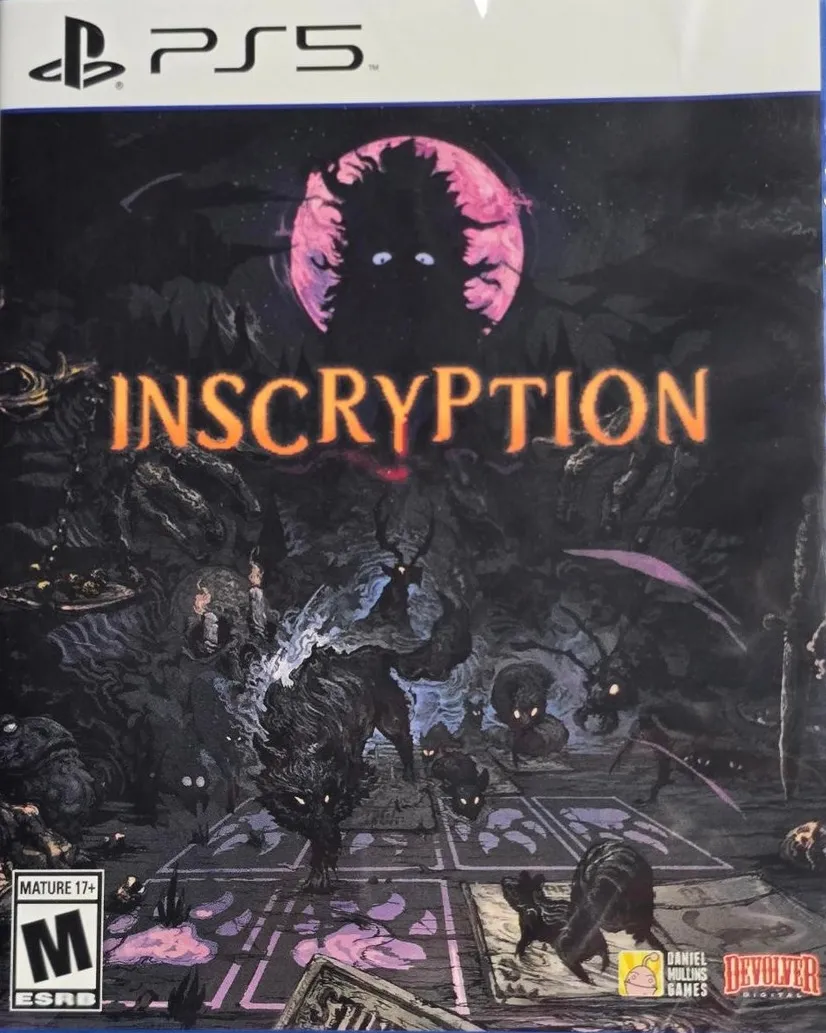
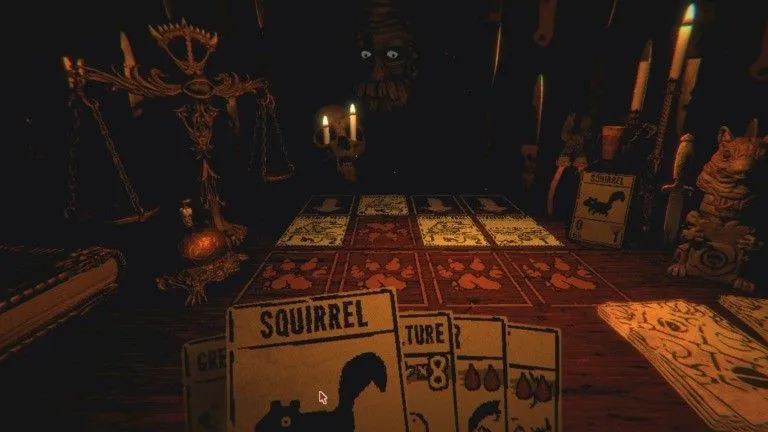
The popular game Inscryption from Daniel Mullins Games, which many call “Indie of the Year 2021”, doesn't wait for you to gather your courage and answer that question. It simply grabs you and flings you right into the thick of events. The bewildered player ends up, unprepared, exactly THERE. In a creepy, incomprehensible place, in a dim little cabin where the wind howls outside the windows and trees creak. And, of course, the poor gamer won't simply walk out of there.
You'll have to play cards — that is exactly what the owner of the little house demands, the sinister shaggy Leshy, whom we see as a dark mass of tangled roots, fur and branches with glowing eyes.
Of course, we are not playing “durak” or “queen of spades” but a full-fledged card battler. Our cards are real battle creatures. They face the enemy's monster cards laid out opposite, and they have attack and health numbers. We begin with the most basic set, but the deck keeps growing as the game goes on, adding interesting new chimeras and upgrading old ones.
Almost all the cards we play require sacrifices — bones or (more often) blood. We get blood by removing any of our creatures already standing on the board. Bones form on their own — when our creatures die. Scary! And it sounds like some necromancer-cultist deck, doesn't it?
In fact, not at all: our cards fit the theme of the forest cabin quite well. We fight with a deck of beasts. In our hands are wolves, deer, skunks, jackals, cats, beetles... On top of that — an endless supply of squirrels. The squirrel is a “basic” creature with zero attack and one health, needed originally only to be sacrificed to get a single drop of blood to summon a more powerful beast.
“Originally,” the attentive reader will ask? Yes. You can't imagine what can be done with a squirrel if you really torment it properly. And the other beasts are by no means simple either! Many have extra abilities of their own — and multi-layered strategies flow from them. Some strike across the whole board, some let you attack “over the head” of the opponent, the snake kills with a single bite, the deer takes a step sideways after attacking.
And they can also be upgraded! And two identical cards can be stitched together by the mycologist-vivisector... A set of little animals that looks simple at first glance becomes, in half an hour to an hour in skilled hands, a zoo of monstrous claws, fangs and poisonous tentacles. The game gets more interesting with every second.
Stopping the game — technically — we can do at any moment. Get up from the table, walk around the cabin, look around, touch the locked safe, the cuckoo clock, try to solve the strange puzzles in the corner... Scratch at the locked door. No surprise, we cannot leave the cabin, the price of the game is life, and the Leshy demands we continue.
The price of the game is life, but what is life if you can always start over? After all, this is a roguelite, and every failure brings something new. A strange card for the deck, changes to the pictures of already familiar “trump cards”, needed items... knowledge. Sometimes it is simply impossible to get further without it.
And, enchanted by the Leshy's narrative magic, the player takes up the cards again. And the figurine denoting the hero travels across painted plains, between key points, between dangerous battles. Here we can trade rabbit pelts (a pelt is also a card!), here — upgrade our beasts, here — give them interesting abilities. And here — another battle with a boss who, as befits a cunning enemy, has many tricks, and you'll have to think seriously about tactics.
This part of the game is wonderful, gripping and simply marvelous. But it takes only a few hours, possibly those very two hours that run up to Steam's refund limit. And what comes next?
It is very hard to talk about the game without scattering spoilers — for example, it is absolutely impossible to post screenshots of the second and third acts. As far as I can see, most reviews are limited to describing the first chapter: the one with the gloomy wooden cabin. One could stop here and, grinning mysteriously with all eight hundred teeth, say “and as for what comes next, play it yourselves!”.
But no. That would be dishonest.
Of course, anyone who has seen even out of the corner of an eye the previous projects of Daniel Mullins Games (Pony Island and Hex) understands that we are tossing cards with evil spirits here not for nothing. Inscryption is fully aware that it is a game, and in the background something very creepy and shiveringly real is going on, not with us, true, but with another person. With a reviewer YouTuber named Luke, whose video-blog fragments we suddenly find here and there — now in a drawer among forgotten cards, now as a reward for a defeated boss.
Luke Carder lived peacefully, knowing no grief, until he stumbled (in a very strange way) on a floppy disk with an old DOS game. The game was called... that's right, Inscryption. And by all rights it should not have existed, because the company that owned that brand only released paper card games. Intrigued, Luke clicked the icon — and with that one simple act got himself entangled in a wild mix of intrigues, madness and other people's grand plans.
Do you think I'm revealing secrets and spoiling the interesting stuff here? Not once, quite the opposite. This is only the small stuff, you will learn it yourself in a couple of hours of play, or even see it in the trailer on the Steam page. A spoiler would be describing the second and third acts in detail. I won't.
But I will say a few things so that players have no false expectations.
Genre-wise Inscryption does not change, does not turn into a gloomy trudge through tangled corridors or puzzle solving (frankly, knowing the author's previous games, I had such a theory). No.
It will be the same card game. Except that the second act is aimed more at assembling a harmonious deck out of a variety of options (for which I liked it — I love that kind of thing!). The third expands the mechanics of the first, but again removes deckbuilding, focusing on diversity of mechanics. If we compare with well-known card games, the second act is like Pokemon Trading Card Game. The third — like Hearthstone, even more than the first.
(Here I was exceptionally unlucky, because I don't like Hearthstone's accumulating mana, and to get stuck with it in the third act... argh!)
Meanwhile, of course, Luke's sudden video blogs continue, growing ever more mysterious. Not hacks but rather battering rams against the fourth wall continue back and forth, the plot hints at something creepy hidden in the game's code, in short, all according to the canons. Psychological horror in all its glory.
It would seem everything is perfect, give me two — what was missing for the author of these lines, who is unhappy?..
First, the third act. One can, of course, say that I am to blame myself and play Hearthstone badly (and that is true). But it, unlike acts 1-2, which are interesting and atmospheric, is unfairly drawn out and offers nothing good between the battles. Even in terms of color palette the third act evokes nothing but gloom. Imagine the most boring lighting, lay a dreary blue filter over it; we will sit in such surroundings for about four hours.
Second, glitches. Inscryption is the first game in N years that, in that same third act, managed not merely to crash in the middle of a fight, knocking the computer into a BSOD, but to crash while killing the DirectX drivers along the way. And my own saves, but that's a trifle, I had backups.
Third, the ending. And it is the game's biggest minus. It disappointed me to the maximum. No spoilers? No spoilers. Play it yourselves and tell me what you think, if you want to argue. As for me, such endings in games (and in works of fiction generally) betray an inability to wrap up a plot properly — whether with an open ending, a closed one, a half-closed one with a twist, any kind. It is an ending in the spirit of “so, now we need to figure out how to finish this, because I haven't come up with a worthy ending”, leaving the player with the feeling of “well, why did I play through all this?”
Pony Island was and remains a wonderful game — from start to finish, a masterpiece, whole, needing no polishing. Inscryption is more like yet another roughly hewn log dragged in by the Leshy from the windfall — it looks interesting, there are beautiful curves, a bit of sawing and it would have turned out sculptural. But all over it stick out some knots, snags, splinters, crooked roots, a side gnawed by a beaver...
A score of 70% — solely because of the two hours that start the game, and because of Kaycee’s Mod currently in testing, which turns those two hours into a theoretically endless roguelike. The rest only counts against Inscryption. Buy it if you want — but only on sale, and be ready for Inscryption to change drastically just at the moment you get a taste for it. (Better still, wait for a stable version of Kaycee’s Mod, which is when the price will drop to a fair 30%.)
This game should have stayed the first act — and that's all. Nothing more. (The second act is good but contrasts too much.) Without Luke Carder's video blogs, without the third act's drag, without the awful ending, because all of this sticks out and destroys the magic. Then Inscryption would have been unambiguously the indie game of the year. Sometimes, to get a masterpiece, you have to ruthlessly take a scalpel and cut off the excess. The author obviously felt sorry to do it — and in vain. They almost held the magic in their hand, but missed it.
Based on material from ProGamer. Translated from Russian.