From the Creators of “Everlasting Summer”: Review of the Visual Novel Love, Money, Rock'n'Roll
A review of the visual novel Love, Money, Rock'n'Roll from the creators of Everlasting Summer: beautiful animated backdrops and music, but weak and selfish characters, illogical routes, a drawn-out 60-hour narrative and many references to memes.
In its time the project “Everlasting Summer” became a real sensation and a noticeable leap for the domestic visual novel market. Created by enthusiasts for devoted fans of Japanese culture, it offered a surprising-for-its-time comprehensive story with pleasant visuals and a stylization close to residents of the post-Soviet space.
Nine years later Soviet Games has returned with a far larger-scale novel whose events take place already in the Land of the Rising Sun, but the spirit of the original with former pioneers, the hammer and sickle and the ubiquitous KGB has seeped in here too.
“Love, Money, Rock'n'Roll” takes us to the expanses of industrial Tokyo, where lives a former Soviet citizen, now an ordinary Japanese schoolboy, Nikolai. His parents, natives of the Soviet Union, died in a car accident, and his ex-girlfriend Ketrin dissolved into obscurity after breaking up with him a year and a half ago. All he has left is a slightly dilapidated house, a pretty neighbor Himitsu who has been in love with him since childhood, and two school friends, Mike and Kyosuke.
The measured school life with skipped lessons, beer gatherings in a Russian-speaking bar and console games goes down the drain one fine sunny day. Rescuing a classmate hounded by bullies, Ketrin's sudden return, Himitsu's pressure and the rude heiress of an industrial empire, Elly, burst into his stuffy life.
The authors try hard for variety, offering four assorted characters for the closest possible acquaintance with Nikolai. But the novel's puritanical bent has not gone anywhere: the most you will see is a heroine covered with a sheet or a model version of a girl in pink underwear. The girlfriends themselves, although templates, are not too unambiguous.
Ketrin behaves like a thoroughly unpleasant and cruel person who guarantees maximally toxic relationships. She mocks Nikolai, having been the first to dump him a year and a half ago, makes vague claims and tries to play the card of an offended wife. Her complete opposite is Himitsu. The girl has been selflessly loving the main hero for 10 years, cooks for him, does his laundry and hopes for something more, but as a character she is an absolute doormat.
The third heroine is that very ugly duckling from a poor family, Kagome. But this girl is nobody's fool. A real psychopath and lover of abusive relationships, where at the end our sweet Nikolai will end up at the very bottom. And finally, the last girl for love — Elly. A capricious heiress and rock star who actively uses drugs and constantly tears herself apart with jealousy. Nikolai himself is no better than this quartet. He wipes his feet on his childhood friend, knowing she loves him, is rude, constantly sends his best friends packing and for half the game fusses over Ketrin as if she were a treasure. His actions are selfish and senseless — at least in most of the chosen branches.
Moreover, the story's routes themselves are divided without any logic. Choosing between “go to lunch with a friend” or “hang around the neighborhood”, you immediately cut off two of the four love interests. And no way back. The other turning points affecting the points in favor of one character or another are far more predictable. Supported Elly — got a bonus to Elly. Went to lunch with Himitsu — plus to the childhood friend's love. But besides the romantic moments, the authors weave spy games, conspiracies and betrayals into the story. It looks a bit strange, especially if you try all the routes and ending variants. Not Nikolai but a young James Bond surrounded by enemies.
The very attempt to present the story in the style of “Monogatari” looks more like graphomania, lengthening an already long game. And if you take all the routes — 60 hours of text is too much even for the most devoted fans. At the same time the authors try very hard to fit into modern culture and memes. Somewhere in the background you can spot Floppa lying on a trash can, a sad Keanu Reeves, and in one of the scenes you will manage to chat with Victor Pelevin himself. And that is not counting sayings, quotes from lad-culture social pages and “Joker” by Todd Phillips.
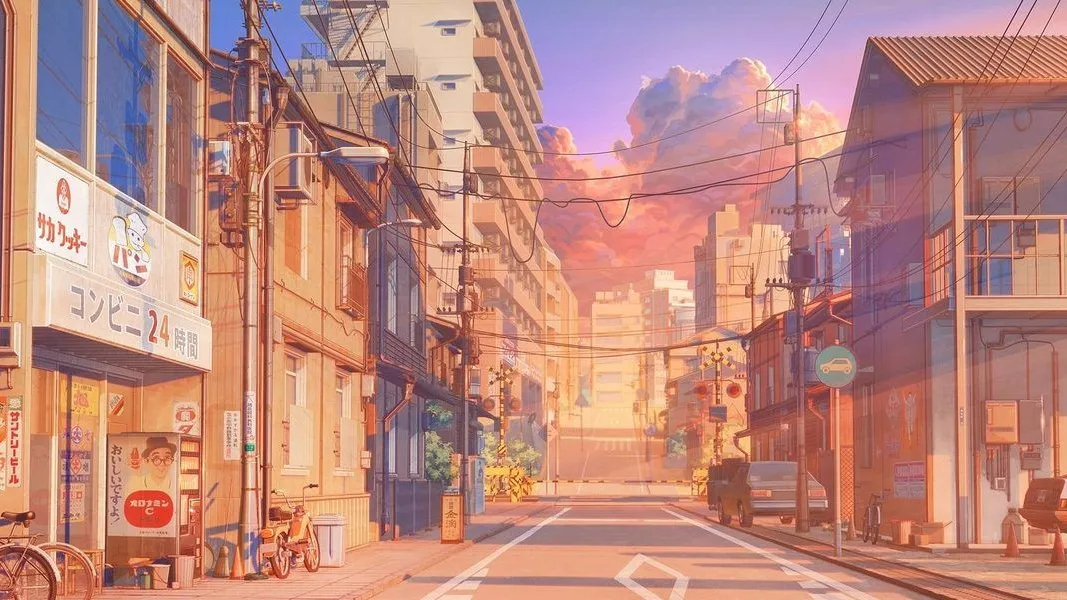
The animated backdrops are one of the novel's strengths. They are worked out conscientiously, delight with high detail and are saturated with various details. Clouds drift across the sky, lights turn on in the windows, and somewhere in the background a train goes by. Simply great. The music, however, evokes mixed feelings. On one hand there is some nostalgia in the melodies, but on the other they quickly get old. Three songs with female vocals could have become an ornament of the game, but the too-ordinary sound and the English language kill all the authenticity.
The graphics and music in Soviet Games' new novel have grown noticeably in quality compared with “Everlasting Summer”, but the narrative is lost in the swamp of graphomania and gloom. And the characters, including the main hero, evoke no sympathy or compassion. Except perhaps Himitsu can be noted for her stubborn foolishness.
It is sad that more than seven years of development and effort went into such a controversial project.
Based on material from GameMAG. Translated from Russian.