Expeditions: Rome Review
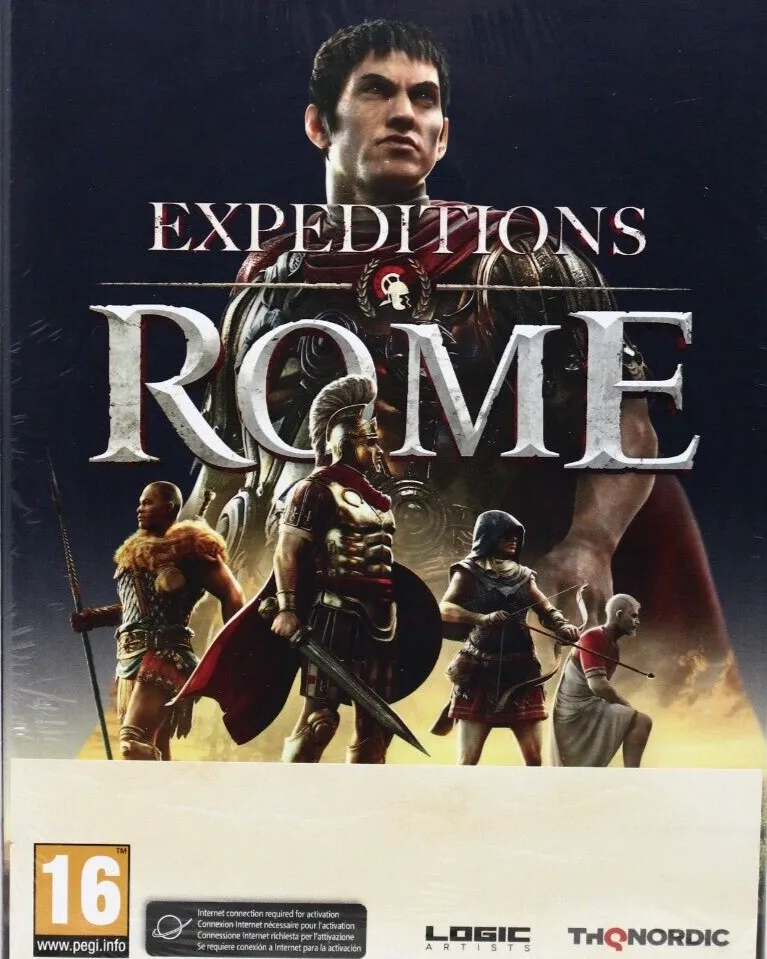
A review of Expeditions: Rome from Logic Artists: a turn-based tactical strategy about a legion in Ancient Rome with battles resembling XCOM; the author praises the tactical combat and criticizes the global map, the legion management and the banal plot, and gives a score of 7 out of 10.
Imagine XCOM turned inside out. The main idea — a marathon of tactical battles and parallel development of your military base — is where it always was, but all the secondary elements and all the scenery seem to have been deliberately swapped for their complete opposites.
Instead of the near future with elements of science fiction — the distant past with real historical figures and events. Aliens, flying saucers... Forget it, that clownery was nowhere near the seething history of Ancient Rome. And instead of gunfights and dashes between cover — mostly hand-to-hand wall-to-wall brawls to the last drop of blood. Which, yes, will be spilled constantly from both sides.
Imagined it? Great. In a nutshell, that is exactly the trick the studio Logic Artists pulled off by releasing its turn-based tactical strategy Expeditions: Rome.
Did the trick work? Let's see.
Blood, Togas and Sand
There is something in the antique aesthetic that every first time turns me away from video games about centurions, patricians and other gladiators. White togas, statues faded before their time, eternal sun and sand — an eye raised on hedgehogs and plumbers misses acid colors and neon lights. You look at the legionaries and understand they were handsome fellows, but you want to play with warriors clad in some even more ornate armor.
A matter of taste, I know. I wouldn't even complain. It's just that in the prologue the game, not content with seating our hero on a boring galley in a boring sea under a boring sun, also immediately shoves a banal political collision under our nose: “The enemy clan burned down the family villa”. After which it demands that we get acquainted with several dummies whom I won't care about at all until they prove themselves at least in an introductory battle.
But it becomes clear right away that the game will have a Plot.
As is well known, in the seven-odd hundred years of Ancient Rome's history only one interesting event took place, and that event is the civil war after which Gaius Julius Caesar became the head honcho of the Roman buns. Everything else is decay, hedonism and decomposition, about which nothing can be made except pornography.
Expeditions: Rome is a decent game, so yes, at the very beginning of the first act we meet a certain commander Lyolik, help him get his battle diary back, and, well, you get the idea.
Ahead looms the inevitable capital disco, but for now we are simply a new commander of one of the legions, tasked with planting the shady Greeks onto our magnificent empire right up to the tonsils.
Piercing and Slashing
After the opening acquaintance with the drama club, Expeditions: Rome makes you involuntarily expect to get the most unimaginative combat system in the world in three minutes.
But no. Bread and real spectacles are indeed on the game's program.
As said above, the main attraction here is turn-based tactical battles, painfully reminiscent of XCOM, yet radically different in where they place the emphasis on the battlefield.
What are we used to? We have a squad that lists guys with rifles, guys with assault rifles, more guys with assault rifles, more guys with assault rifles. Maybe a couple of shotgun lovers. And one crazy samurai running across rough terrain with a hybrid of a sword and a chainsaw, purely for variety.
Here it's the opposite. Our main arsenal is swords, poles, spears, knives and other weapons that are best used up close to the enemy. Yes, somewhere back there an important but lonely archer supports the squad. If you really want, two archers, though in that case there is a serious risk that the vanguard will crumble.
Because conflicts here are settled hardcore, face to face. I would never have thought it in advance, but the butting of six units on six adjacent tiles turns out to be not a mindless exchange of attacks but a whole science with non-trivial chains of actions.
It is especially pleasing that every single class and every (well, al-most) move has its place. A universal algorithm for all tactical battles of your life will not be found. Partly because the combat puzzles are prepared very different, partly because half the moves are tied not to character development as such but to different weapons. Sometimes you seem to want to keep a familiar set of actions and live with it to legionary old age, but the dagger you just found on the battlefield is so good in plain damage numbers that you cannot help being tempted.
All in all, the tactical battles are a success. I would only remove the local Molotov cocktails from the game entirely, since they hit everything in the world far too hard and cut down the room for maneuver. Otherwise, everything is great.
Creeping Sawmill, Lurking Mine
The breaks between tactical battles are filled with trips around the global map, the usual development of the base (that is, our legion's headquarters), simple strategic management of this very legion and love-and-plot dialogues.
Alas, I do not feel like praising Expeditions: Rome for any of these pastimes. There will be something to scold it for, but not very strongly either.
Least pleasing are the hops across the global map. The first, probably ten minutes spent scouting the region in the style of Heroes of Might and Magic, evoke that, you know, pioneer's interest. Then you realize that the game for some reason really wants you to hunt for pixels. That is, to peer at the overall canvas and pick unremarkable points of interest out of it with your eagle eye. Only the most important landmarks of the map cannot be missed; all the other objects — from mines, sawmills and farms to random supply caches — are so skillfully fitted into the scenery that you can easily never notice them at all.
Sorry, but I am used to every even slightly important post in strategies standing out against the general background. Being marked with an icon on the minimap, being painted brighter than plain decorations, so that I immediately and without any extra effort understand that there is something interesting here.
No, missed the quarry — then missed it.
Moreover, I'm not sure the designers staged games a la Myst on the map on purpose. During the first campaign I guessed that I had overlooked several landmarks somewhere while working out what resources I needed to make one of the base camp's basic upgrades.
It can't be, I thought, that E:R still hasn't given me iron for the very first garrison upgrade. It turned out that it really had, I had simply overlooked as many as two mines.
Attack on Autopilot
As for the command of the legion itself, uh, it doesn't annoy but doesn't particularly please either.
We have a controlled crowd of Romans with swords wandering from one checkpoint to another. We will of course see no epic battles of thousands of dummies on screen, this is not that kind of game. Only statistics figures — the number of fighters, their morale, food supplies.
Yes, there is also a certain separate morale of the centurions, which gets tossed back and forth depending on the player's actions along the way. But the influence of the commanders' moods on the game is felt even weaker than the moral dilemmas of Mass Effect 3 on its ending.
To advance further in the campaign, the legion has to consecutively knock the same faceless crowds out of their strongholds, then capture the aforementioned sawmills, then everything anew. Having worked over n camps and sawmills, we build ourselves new tents in which we forge the best armor, heal the staff, chat with party members about life, all the standard stuff, all in the well-known circle named after XCOM plus a bit of dialogue politics and romance.
The process of capturing the main control points is presented with endearing scenes with the unofficial name “Total War for the very little”. During the performance random cubes, rectangles and circles denoting our valiant troops and disgusting enemy hordes will, to samples of clanging weapons, squeeze and unsqueeze like an accordion, wash over, retreat from each other and pretend that something important is happening on screen.
We are even allowed to adjust tactics, three times per clash.
There is no deep meaning in the choice of tactics, nor in contemplating the animated little arrows from school history textbooks. The first battle you watch from start to finish out of sporting interest, the third you begin to skip ahead to the choice of stratagems, somewhere around the sixth geometric showdown you switch on the provided autopilot and forget that such a thing even exists in Expeditions: Rome.
In general, the game manages to dilute the main gameplay with all sorts of routine tasks, but just at the minimum, absolutely without a spark.
We've Already Seen This Series
Finally, all the missions, incidents and campaigns are glued together by that very Plot with Heroes.
Alas again. E:R plays out the most worn-out plot in mass culture and offers the most standard companions. A Roman patrician begins a forced military career before the civil war, then makes do as best as possible during that very war, then lives through its aftermath. Among the protagonist's companions are: barbarian gladiators, a veteran legionnaire, an elderly mentor-servant with a rich past, a renegade patrician...
Yes, you can flirt properly with some of them. If you wish, of course.
In short, there is a plot. A couple of episodes even turned out interesting. Let's praise the studio Logic Artists for the attempt to bring deep plot twists to XCOM and wish it great success in the future.
**
Very, very good basic mechanics are built into the game, that can't be taken away. The tactical battles, once again, are very good. They pull everything else — not bad, but not especially interesting either — in E:R up to a score of 7 out of 10. Make the global map tasks more meaningful and the story brighter, and everything will be great.
For now, this is how it is: we have not an excellent but simply a good tactical strategy. But for once not about gunfights and not about aliens.
Based on material from ProGamer. Translated from Russian.