Crazy Ordinariness: Clash: Artifacts of Chaos Review
A review of Clash: Artifacts of Chaos from ACE Team: the author calls the game ordinary and boring against the backdrop of Zenozoic's crazy setting, criticizes the landmark-free navigation, the monotonous fights and the dice mini-game, but notes the beautiful visuals and music.
Long ago the Chilean studio ACE Team marked itself by releasing the duology Zeno Clash — strange first-person games whose events unfolded in the whimsical world of Zenozoic and introduced the audience to the characters inhabiting it. What those games were about you may no longer remember, but the setting surely must have stuck in memory — a surreal take on the conflicts of motley tribes with unique traditions, ideas and culture. An adventure like a feverish dream. A wild fantasy about what never existed.
Only Zenozoic did not appear to you in a vision at all. It existed, and continues to exist. Which ACE Team tries to remind us of with Clash: Artifacts of Chaos — its new game, which is meant to take the old setting and put it on completely new rails.
First of all it concerns the change of perspective. If the two parts of Zeno Clash offered to look at the surroundings through the main hero's eyes, Clash: Artifacts of Chaos uses the over-the-shoulder camera traditional for many modern games.
Another change is the overall structure of the project. Clash: Artifacts of Chaos has no linear sequence of levels; instead the game offers to explore in a relatively free manner several interconnected regions of Zenozoic at once, existing in two planes simultaneously.
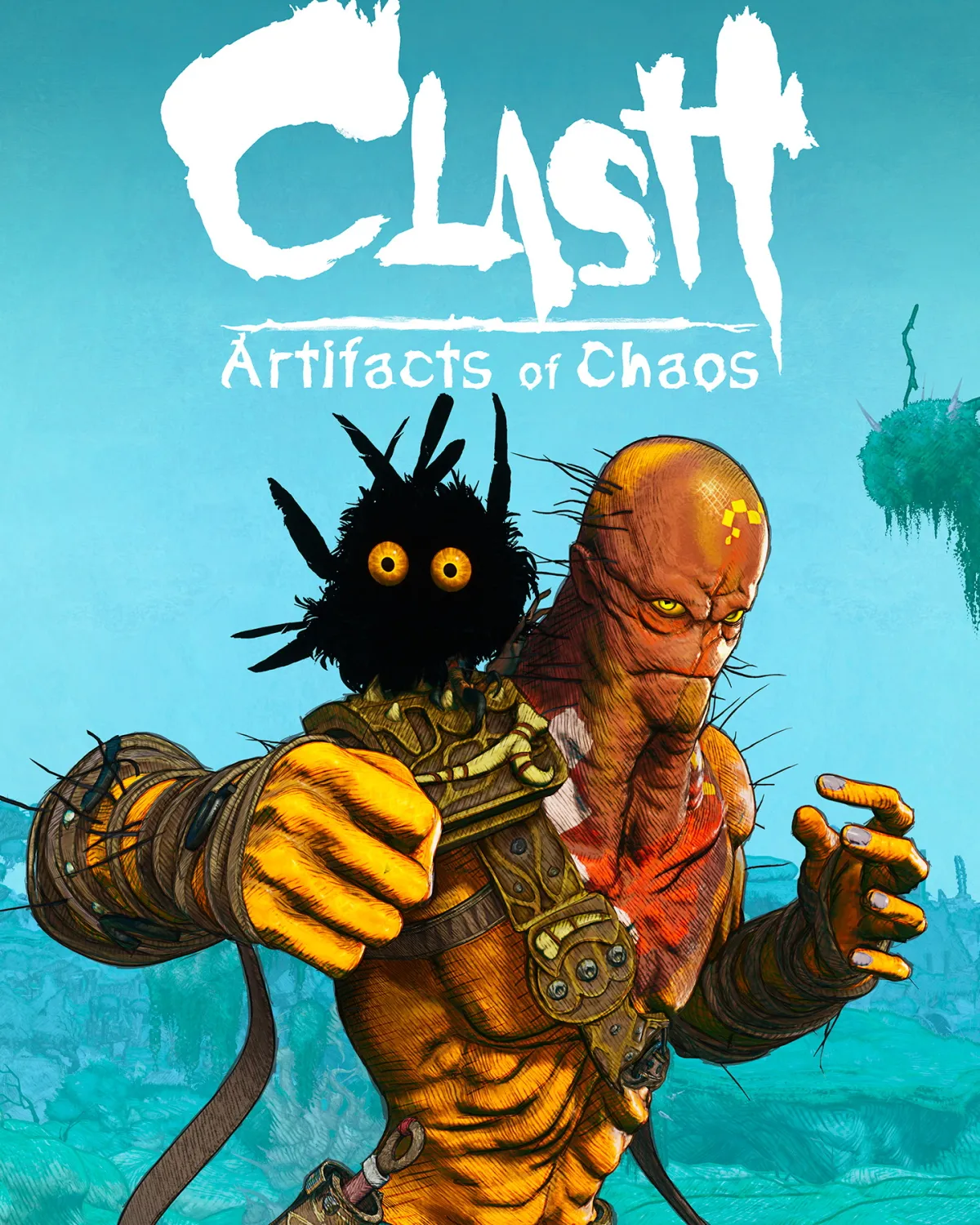
The narrative is told from the point of view of the hermit Pseudo. The wandering warrior prefers to avoid gatherings of other creatures and lives on the road, content with a modest way of life. One day the hero witnesses a great injustice — an evil malefactor kills an old keeper and leaves a little ball of feathers an orphan. Deciding not to abandon the child to the mercy of fate, Pseudo puts the Baby on his shoulder and promises him a calm walk to the nearest city, where he will find a new home or temporary refuge.
The plan, however, is not fated to come true in full. Reaching a settlement, Pseudo realizes the Baby is not a simple child at all but a magical creature with the ability to restore living energy. The Baby's amazing healing properties turn him into a target for the dangerous mistress Geminai, from whose hands Pseudo will now have to save his little companion.
The setup is simple and largely functional. The main events are conveyed through short cutscenes and dialogues, and their mission is to send you on a journey, having first charged you with minimal motivation. The game briefly explains that to defeat Geminai the Pseudo you control must first find four special artifacts — only that way can the villainess be defeated. And so begins a new odyssey across Zenozoic.
The world of Clash: Artifacts of Chaos is divided into several zones. Each is a large level, an interweaving of narrow corridors and passages formed from natural formations. In some places you will make your way through dense jungle, in others jump across sharp rocks, sometimes you will have to sink into swamps, and more rarely forge a path through caves of unknown origin.
There is essentially no direct order for going through the available locations. Almost from the very start of the game you can form a route yourself and set off in any direction, on a random impulse of thought. Such freedom ultimately becomes one of the central problems of the whole game.
It is extremely hard to find your way in Clash: Artifacts of Chaos. It is obvious that the project is inspired by current adventure games, offering to spend hours exploring complex levels that connect to each other in unexpected positions, where every new turn promises a great reward or danger. You can spend several minutes making your way forward through an unwelcoming landscape and then find a big stone block, interacting with which opens a passage to the very start of the level — all that remains is to gasp at how structurally complex the location turned out.
The picture is darkened by the fact that the developers at ACE Team forgot or didn't take into account that navigation through this kind of labyrinth requires at least some intelligible visual landmarks. Almost every local location, as a whole or broken down into its components, at some point inevitably merges into a barely distinguishable mush of seemingly randomly piled-up geometry.
The extremely conditional navigation rules dictate that Pseudo can move only along strictly defined coordinates. A tiny fence may be an insurmountable obstacle surrounded by a thick invisible wall. Another hundred meters on, you can bypass the same kind of fence without any problems. What distinguishes them is not entirely clear. And you learn about the differences only after trying, experimentally, to lay yourself a new path.
Also, the game has no map of any kind. More precisely, there is a map — a small window showing which of several regions you are in at a given moment. However, learning your exact position doesn't seem possible. Of course, the lack of a detailed map is not a sin or a crime. There are many other games, including those the new creation of ACE Team noticeably references, where such an approach is fully justified. But in Artifacts of Chaos the impossibility of looking at a map will certainly make itself felt, and almost from the very beginning of the journey.
Because of the problematic navigation mentioned above you have to keep running circles around the same places, desperately hoping that by accident you missed some inconspicuous trigger or interactive object. However, the real state of affairs is far more banal — to progress further you merely needed to slip into a small cave hidden behind a gray rock neighboring another hundred gray rocks against the backdrop of a big gray wall. Here one may scold one's own inattentiveness. Or the developers' inattentiveness. Whichever is more convenient.
One of the features of Artifacts of Chaos is the so-called dream world. Entering it, Pseudo takes on a new physical incarnation, and previously familiar locations change not only outwardly but also in the details of their content. If one tries to give the game a very positive characterization, the concept can be compared to the parallel world from the duology Legacy of Kain: Soul Reaver, where Raziel moved through two layered realities to solve puzzles and spatial tasks. The system here is similar, only there are no puzzles or tasks — most often you need to run to some point, collect optional chests with items and defeat an enemy whose death opens new paths in the waking world.
If it seemed strange to you that the presence of enemies and fights with them in the game hasn't been mentioned in the text for so long, don't be surprised. The combat system here is quite simple, and there's not much to say about it. Even though it occupies the whole portion of the gameplay free of frustrating wandering around unwelcoming levels.
The mechanics are as follows. Pseudo can hit. The hero hits with a series of four successive attacks. Each is initiated by pressing one button — no input delay or rhythmic pressing, one press — one blow. The next option is a special attack tied to another gamepad button. Finally, there is a dodge and attacks tied to it — depending on the dodge direction Pseudo can perform a unique lunge toward the opponent.
Standard and special attacks can also be customized. The former depend on the chosen style — there are several in the game, differing in animation speed and damage. The latter are unlocked in the course of progression and are unique moves such as leg swings, uppercuts and so on.
Having found or bought a weapon from a merchant, Pseudo can use it in battle. Various bats and hammers are not tied to the chosen style and set of attacks, instead offering their own simple series of strikes. Weapons have high damage values but tend to break quickly.
With the arsenal described above you will solve all the problems that fall on your head. Fights take place in different formats — most often Pseudo fights alone, while there may be several opponents. Enemies rarely have more than three or four unique attacks, and the types of opponents are extremely limited — you will quickly get used to each of them and memorize an effective sequence of actions, which usually boils down to two or three blows, a dodge and a super attack.
It must be admitted that a random barrage of blows in Artifacts of Chaos is a tactic that is certain to lose. The game offers nothing complex but asks you to find the right rhythm — to hit and dodge at the right intervals, and also to keep in mind the ability of enemies to punish thoughtless actions. For example, almost every enemy has the ability to swing behind its back, not allowing you to deal excessive damage by going around the opponent from behind.
Another curious mechanic shows up in battles — the defense and attack gauges.
The defense values determine the amount of damage Pseudo takes after each missed blow. When the bar drops to zero, damage to the character is multiplied, which motivates either playing more carefully or, on the contrary, more aggressively — counterstrikes restore the defense value.
The attack is a bit more interesting. Having built up this gauge, you can temporarily enter a special mode where the camera changes perspective to first person, not only recalling the original Zeno Clash but also changing Pseudo's movements. Having switched to this option, it is in your interests to rain an endless series of blows down on the enemy, after which the hero can perform a separate finishing move on the opponent that erases a substantial part of his health.
The root of the evil lies in the fact that despite a quite competent implementation of the third-person combat system, fighting in Clash: Artifacts of Chaos is simply boring. There are few enemies, and they can't offer serious resistance. Pseudo has many attacks in total, but the use for all of them is the same — hit until the enemy falls. It won't be hard, fun or engaging. It will be monotonous. The enemies inhabiting the world and prone to respawning after death will sooner or later inevitably be ignored by you — there is simply no reason to hit them for the tenth time.
It seems the developers themselves understood everything. So they tried to diversify the fights with an additional superstructure — a funny mini-game activated before some of the battles.
Within the setting the creatures inhabiting Zenozoic can challenge each other to a game of dice. It looks like this: a field divided into four parts is laid out on the ground, into which the dice are thrown. The player who throws more points than their opponent comes out the winner. Depth is added to the process by special seals with which the thrown dice can be manipulated — destroyed, their faces changed, points zeroed and much more.
Having won such a game, you can activate a special artifact. With its help various modifiers are introduced into standard fights. Some artifacts cover the arena in fog, some deal passive poison damage, some can summon helpers. The thing is that in case of victory artifacts can be activated not only by Pseudo but also by his enemies, because of which each new fight may begin either with a noticeable advantage or with complicating circumstances.
On paper — great and engaging. One cannot reproach ACE Team for the creativity of its approach. In practice it turns out that quite quickly the dice turn from an interesting curiosity into routine. Each round takes several minutes, merely delaying the moment when the duel finally takes place. And the modifiers themselves hardly have a strong effect on the outcome of the battle — everything is perceived as external attributes, no more. In optional battles the dice can be calmly ignored, which you will most likely do — it's faster.
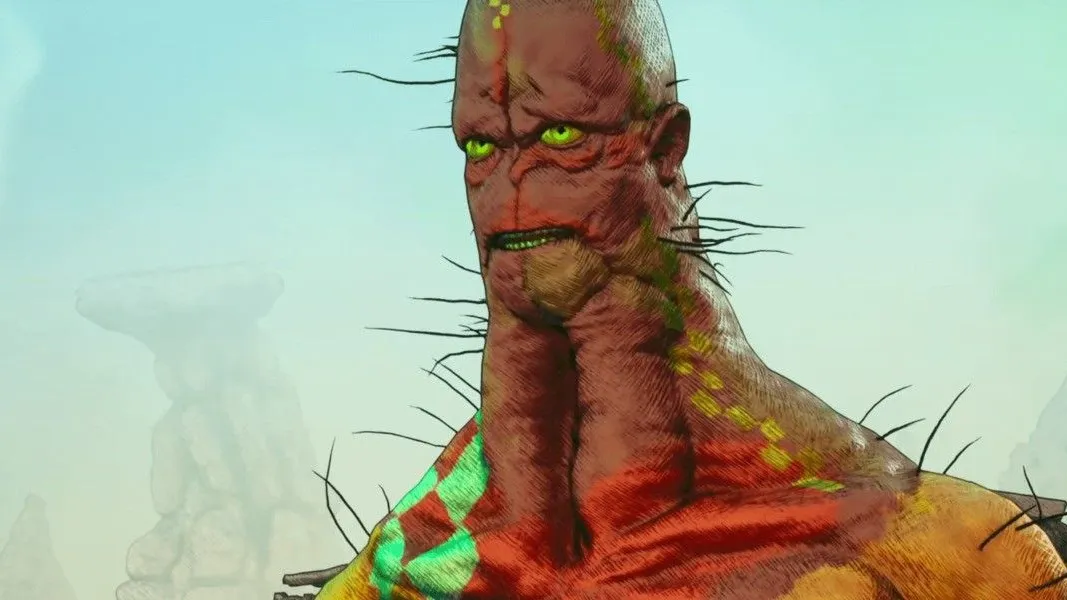
Alas, the desire to rush past a decent part of the content of Clash: Artifacts of Chaos is the idea dominating the whole acquaintance with the game. Sometimes the project successfully persuades you to stop and soak in the surroundings. The work of the artists, employing unusual designs and an inventive rendering model of the image with thick pencil strokes, is capable of producing beautiful imagery. The music too can resonate successfully with the spirit — some melodies boast wonderful harmony and an interesting combination of instruments with fairy-tale female vocals.
But most of the time you simply don't want to breathe in Clash: Artifacts of Chaos. Everything is too ordinary, accessible and simple. Which is especially painfully perceived against the backdrop of the crazy external aesthetics. Weaving the familiar and the unknown into a single canvas is an undertaking that ended in failure. Zenozoic is meant to surprise. But in this game you won't manage to be surprised.
Based on material from GameMAG. Translated from Russian.