Black Book Review: Cards, a Book and Sorcery
A review of Black Book from Morteshka: a card role-playing game with visual novel elements built on Slavic mythology, set in Perm Governorate in 1879; the author praises the card battles, the investigations, the music and the folklore, and criticizes the 3D locations and the puzzle battles, rating the game highly.
Slavic mythology is not often found in video games. Unlike many other myths and legends. Strange, isn't it?
We remember that Zeus did not get along with Hera and gave birth to Athena himself from his head, we know who kitsune and bakeneko are, we can easily tell where and from where Odin spilled the mead of poetry while flying to Asgard. But why do we know so little about our own past? Fine, mythology, fine — kikimoras, leshies and bannik (bathhouse spirits), but who can say offhand what “seni” (the entryway of a peasant hut) and “ovin” (a grain-drying barn) are? (No, not “seno” [hay] and “oven” [Aries].) What are “polati” and “matitsa”? What is “rosstan”? Yes, obsolete words, but they were not so obsolete even a hundred years ago.
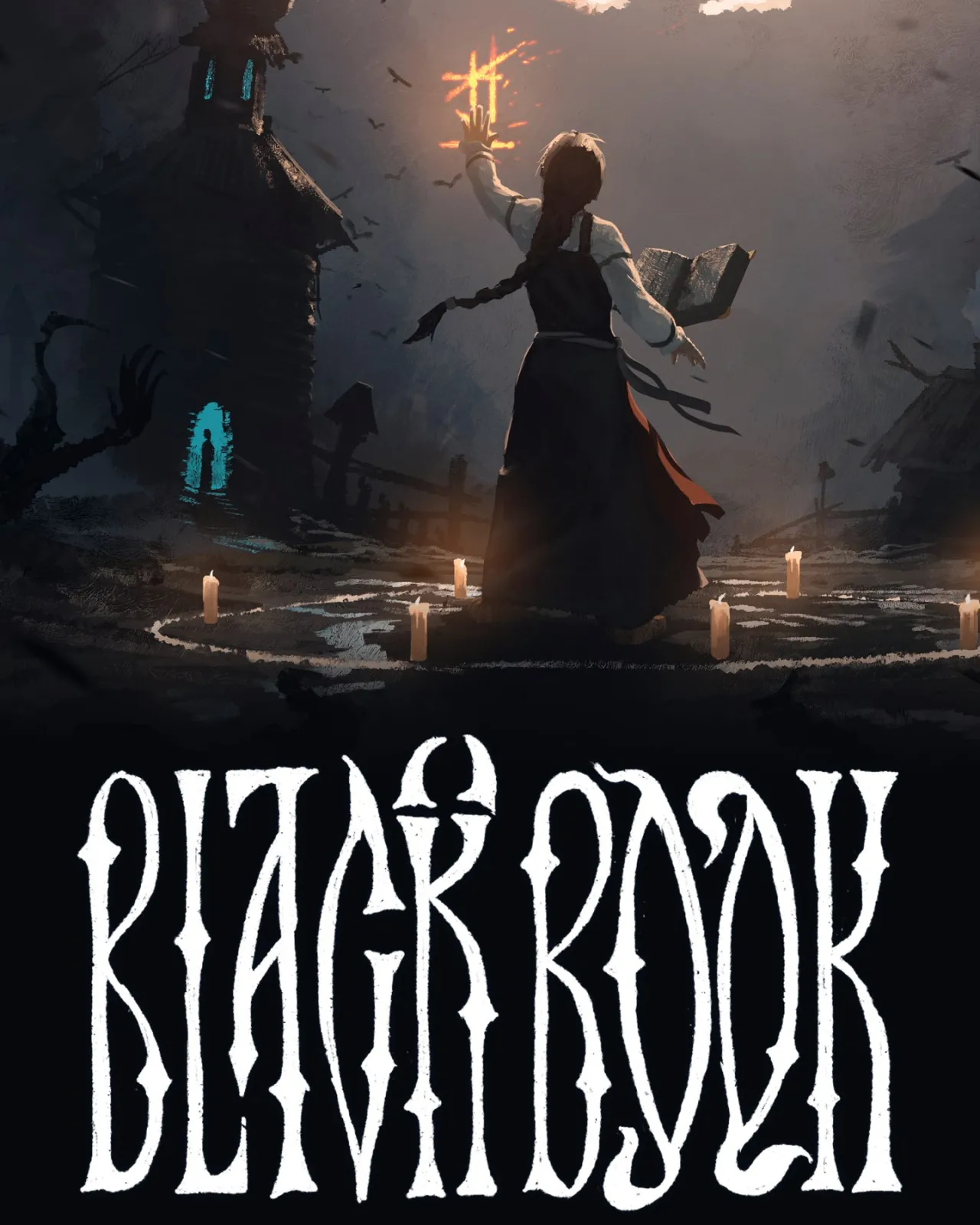
The game Black Book from the studio Morteshka (the creators of Mooseman) successfully fills this gap. And not in the form of a boring encyclopedia but in the form of a gripping and creepy RPG. The action of which takes place — suddenly! — in Perm Governorate, in 1879. A dark, frigid time. The northern backwater of the country, where for peasants even Cherdyn is a huge city, and as for Perm itself it is scary even to think. Act one — begin!
Too many male stories begin with “and so the hero set off in search of feats”. Too many female stories begin with “once upon a time there was a girl, and it was her own fault”. Especially in Russia, and in the late nineteenth century at that. The girl Vasilisa grew up an orphan in the care of her only relative, the old sorcerer Grandfather Yegor living on the outskirts of the village. Yegor offered her too to become a “znatka”, that is, a witch. Vasilisa refused because she had fallen in love and wanted to marry.
But when her betrothed hanged himself without cause or explanation and was buried outside the church fence (as is proper for suicides), Vasilisa decided — enough! As they say, to Hell with this! Literally: she has to undergo initiation as a sorceress, descend into Hell and take in her hands the Black Book that once belonged to her teacher Yegor. According to legend, if a “znatka” person manages to open all seven seals locking the Book, the artifact will fulfill their most cherished wish. Naturally, Vasilisa's cherished wish is to bring back her beloved. The rest is secondary.
(Who in the back row mumbled that one shouldn't dabble in unlicensed necromancy? Don't stand in the way of an angry woman!)
The story is divided into chapters corresponding to the seals on the Book. The seals are the most varied: water, aspen, wolf... Opening them will also, of course, require unconventional methods. Not a problem: mentor Yegor will advise on some things, and elsewhere other helpers will turn up! The stories are truly gripping, and each tells about completely new evil creatures, about sorcerers, about local superstitions and omens. Vasilisa will have to organize someone else's wedding, run through the forests after werewolves, make friends with a talking skull, visit the chambers of the water spirit — and do another million things!
Black Book is a blend of a visual novel with a card game. The cards are pages from that very Book, so at first, while only one seal is broken, Vasilisa has only basic “spells” available. The number of spells we can cast per turn is also limited.
The card-battle part of the game is beyond praise. We start with the simplest cards — a few attacking, a few defensive. Little by little, breaking the seals on the Book, we unlock complex and multi-layered ones with which all sorts of combos can be made. Closer to the middle and especially the finale the player is already able to tune a narrowly focused deck to their needs (I, for example, found it most convenient to use a fast black, maximally debuffing set of cards based on Curse). There are cards that “burn out” when used, there are cards that remain in a plot-spell for several turns and strengthen it.
Our sorceress is not a witcher with a heavy sword, she does not know how to wear chain mail, so of items she can use only light “amulets” (six at most, used as an analog of armor) and various useful herbs (used in battle as an instant-action item).
The battle itself looks three-dimensional and... well, not spectacular but convenient. Vasilisa with allies on the left, enemies on the right, cards “in hand” at the bottom, cards “in plot” at the top. Defeated evil spirits picturesquely writhe or crumble into puffs of soot. True, sometimes I wished the screen were brighter: in some fights with a crowd of devilry in the dark it is hard to make out anything, never mind black devils in a black room! But nothing can be done: Vasilisa has to do her sorcery at night. And decent lighting along roads or even pocket flashlights have not been invented yet.
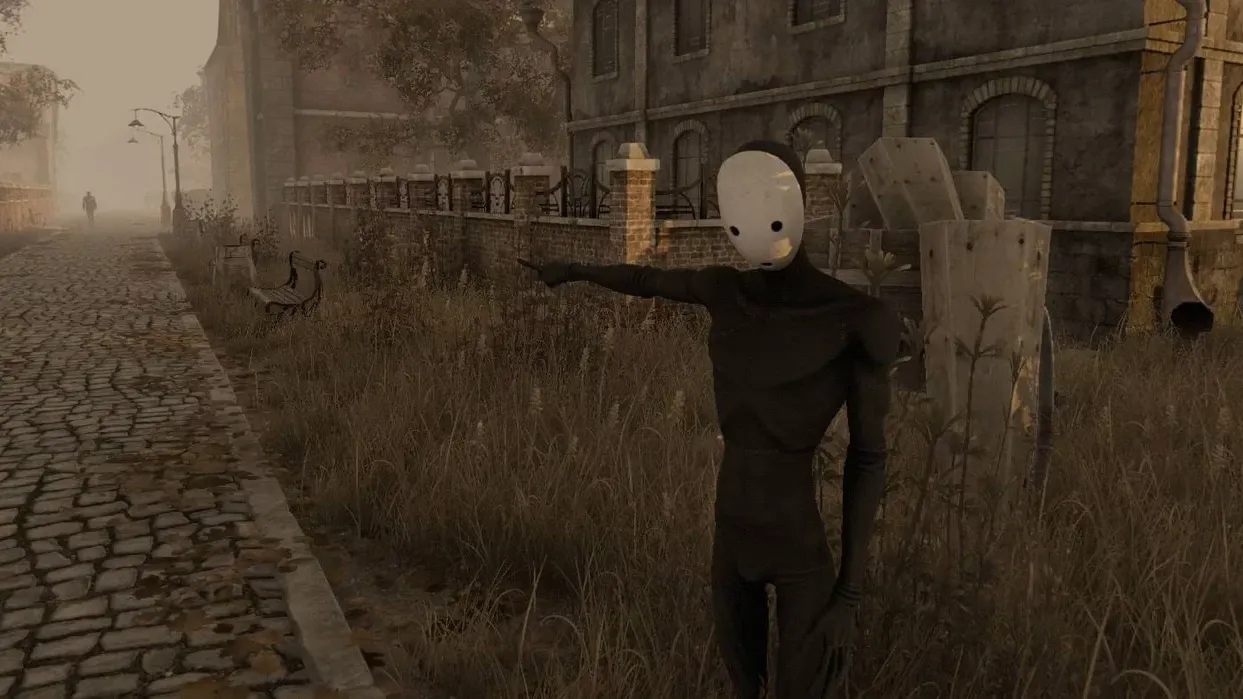
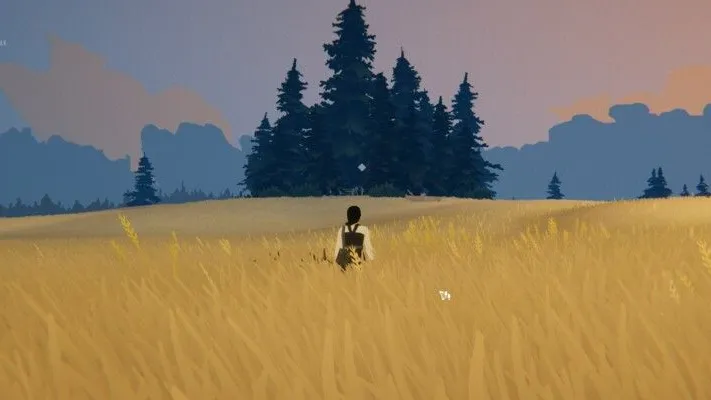
But here is a minus, though a small one: the engine, which displays the turn-based fights quite decently, is utterly unsuitable for three-dimensional locations. The game periodically has moments where we run Vasilisa around small areas and explore the surroundings for key points. This is, without exaggeration, a horrible horror. The heroine stumbles over invisible barriers, the camera follows her with the grace of a lame kikimora, flat little fir trees and flowers, so beautiful on static screens, shamelessly leap into the eyes... Better these stages were removed altogether, honestly. Or made in any other engine, even RPG Maker.
All the rest of the “action” takes place in visual novel format: every day (or rather evening — remember the sorcery, right?) the heroine meets in a hut or at some rest stop where you can chat with partners, play a few hands of cards, sort the inventory and talk to petitioners. Petitioners are those who need something from the sorceress, and there are usually plenty: of course, the late nineteenth century, the backwoods, doctors from the capital can't be summoned, witchers from Rivia even less so, and there are enough reasons to worry. Now a child falls ill with fever, now an old man gets lost in the forest, now there are simply incomprehensible sounds and creaks at night — scary!
And then we set off and the most interesting part begins — playing detective! No, the card battles are also wonderful and very fun, but the little investigation puzzles I liked most of all in the game. And in the dialogues or in the folk tales-encyclopedia before the task we are always given hints, we don't have to poke at random — you just have to think and read carefully.
(Right before Black Book I played Ace Attorney Chronicles — the contrast of cultures was especially striking. In England at the end of the nineteenth century there are steampunk, airships, steam engines — and in Perm Governorate herbalists, demons and superstitions, and it's good if one priest in the whole village understands letters. But the detective part... suddenly turned out similar!)
How do you expose a changeling baby? (No, not an elven one). How do you get out if you've gotten lost in the thicket and suspect that the “master” is leading you around? What kind of monster is an “obderikha”? How does the “susedko” differ from a neighbor? Who spins yarn in the hut at night — a kikimora, a shishiga or a house spirit? How do you drive a rusalka out of a well? Such are the everyday questions for a sorceress from Cherdyn.
And the episode “recognize the leshy in human guise among many suspects” with a search for clues and questioning of witnesses is simply posh-chic, Phoenix Wright would approve.
Black Book is not just a fantasy. Already in the developers' previous game, Mooseman (“Man-Moose”), a fair amount of Komi-Permyak mythology was sprinkled. In “Black Book” there is so much information on the beliefs of the Perm Governorate peasants of the nineteenth century that the game can safely be considered educational.
You probably know yourselves: Christianity, which came at the end of the IX century to lands where idols and spirits of the elements were worshipped, changed, adapted, and a few centuries later no longer resembled the “original”. Pagan festivals were bizarrely mixed with church ones. Sacrifices made to minor gods were redirected to leshies and water spirits. Lesser spirits harming people became “bisi” and “chortyaki”. Icons of saints that did not fulfill requests were punished with rods as “worthless”. At cemeteries food was still left for the dead — and still is today!
The resulting faith turned out very strange. By the notions of most peasants heaven was somewhere out there, unclear where, and angels were not visible — but hell is right here, demons are right here, roaming everywhere! No wonder everyone needed sorcerers, sorceresses and “znatki” who could somehow make sense of the disorder going on. But, as is customary in dealings with otherworldly forces, ordinary logic does not apply here. You can trust only your intuition and the incomprehensible logic of alien, foreign rules of behavior drawn from old tales.
One of these rules is quite funny (and we read about it in Gogol): evil spirits love to play cards! And well, who doesn't. The main game both for people and for devils in the district is “podkidnoy durak”, simple but addictive. Often, by offering to play a few hands, you can avoid a fight, or even earn money.
Note that otherworldly scoundrels can cheat, swapping plain cards for trumps... but then our Vasilisa is no slouch: over time you can both level up skills allowing the same and find items that help in cardsharping.
Music adds a fair share of atmosphere to the game. It is drawn-out, plaintive, pensive — as if you really are trudging along a dusty road on a summer evening with the gloomy tops of pines closing overhead. A wonderful addition are the folk songs performed by the student choir of the Perm Regional College of Arts and Culture. I never considered myself a fan of the genre, but listening to “Oy, kumushki” or “Sidel voron” while watching light clouds run across a dark sky and the roofs of village houses in the post-sunset gloom turned out to be unexpectedly great. (Yes, the backgrounds in the game are magnificent too.) The characters are fully voiced, and the local pronunciation is not forgotten either.
Black Book, of course, has several endings — as befits a decent RPG. Which ones, I won't spoil. You'll work it out yourselves. I'll only say that the choices made during the game resonate in the final chapter in the most interesting way.
In any case you finish the game wiser by many authentic words, fascinating tall tales and little-known facts. The developers managed to combine a good RPG with a full excursion into the nineteenth century. A difficult task — and carried out to a full 120%!
I won't say the game is perfect; no. I did not like, for example, the puzzle battles where you must win a fight in the only possible way with a pre-set deck (judging by the Steam forums, few liked them at all); I prefer freedom of action. The graphics in the 3D locations, as said above, leave much to be desired. But these, honestly, are trifles. The game definitely deserves your attention.
Based on material from ProGamer. Translated from Russian.