Beta Test of “The War of the Worlds”: A Review of Somerville
A review of Jumpship's Somerville: a Playdead-style alien-invasion adventure with striking visuals and atmosphere but a rushed release, a murky ending, poor performance, collision bugs and clumsy controls; the author says it needs another six months of polish.
The creations of the studio Playdead have always held a special place in players' hearts. Having done away with any dialogue altogether, the developers invited players to plunge into surreal horror worlds in which the story was open to interpretation and the concept of a “left-to-right walking simulator” was diluted by physics-based puzzles.
Only the franchise Little Nightmares from the studio Tarsier could compete with Limbo and INSIDE. The latter varied its colleagues' concept by turning the levels into something like dioramas and also offered its own unique and very creepy story.
Now Playdead is in radio silence, occasionally sharing atmospheric art of a new project on social media. Tarsier, for its part, left Namco Bandai's wing and lost the rights to Little Nightmares.
The vacated niche was quickly taken up by the studio Jumpship, whose core consists precisely of former Playdead employees. Having secured the support of Microsoft, the team announced its debut game in 2017 — Somerville, which was clearly created on the pattern of INSIDE.
For the last few years Jumpship sat quietly, but in the second half of 2022 it suddenly woke up and promptly dumped its long-in-development project on Xbox Game Pass. Given its quality, the decision to force the release was clearly made not out of good circumstances.
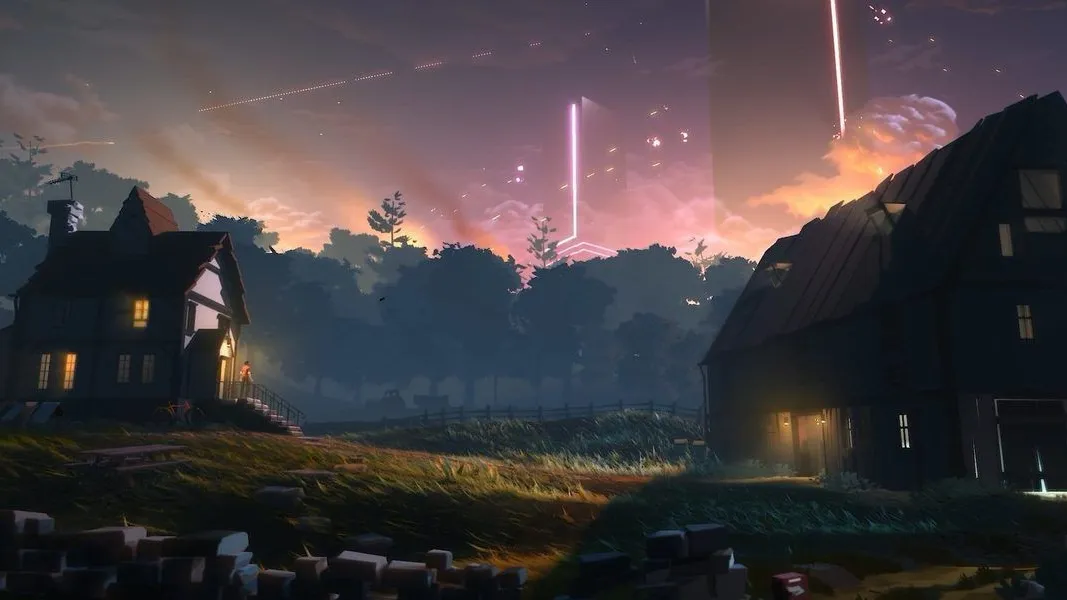
The story focuses on a family living outside the city (presumably in Great Britain), consisting of the main hero, his wife, a small child and a dog. But their peaceful life changes when a giant black monolith appears in the sky and bombards people with giant rods of an unknown metal.
Because of the incident with a space fighter crashing into the house, the main hero is separated from his loved ones. Now he must find his family and survive in the chaos.
On first acquaintance Somerville is indeed hard to tell apart from Playdead's creations. Here too none of the characters speaks, and players must explore a mysterious world filled with dangers.
However, Jumpship tried to distance itself from its former colleagues with two decisions. First, the approach to level construction was revised. While Limbo and INSIDE looked like 2D platformers, in Somerville the locations are more open and the camera constantly changes angles in an attempt to make the adventure more cinematic and spectacular.
There are also not many physics-based puzzles. Instead, the developers gave the main hero two abilities that let him, using light sources, change the state of matter of alien constructs (solid or liquid).
On paper Somerville looks like a very promising creation. But very quickly the understanding comes that something went wrong during development.
Let us start with the positives. Jumpship's creation at first causes sincere delight with its memorable visual style and its work with the environment. The developers were clearly inspired by “The War of the Worlds” by H. G. Wells, so the local atmosphere can be drawn by the spoonful.
In addition, a great emphasis is placed on the spectacle of what is happening. The once familiar world of the hero has turned into a dangerous environment that presses on him with its scale. The player sees monstrous landscapes with giant structures, a destroyed city, a wrecked tent camp around an empty stage with a caricatured UFO (apparently the local population was awaiting first contact) and so on.
When the action starts, the whole game comes into motion thanks to great attention to small details. Fabric flutters in the wind, the hero leaves tracks in clay, and the alien hounds chasing him smash through scenery and destroy vehicles standing in their way.
However, at some point the narrative stops being straightforward and stalls. Somerville's ending turned out overly unclear and open to interpretation, and it does not cause a mind-blowing effect in the spirit of Inside but leaves a feeling of bewilderment and disappointment.
It all looks as if in the middle of development Jumpship pressed too hard on action and did not calculate budgets. When the money ran out, the studio hurried to finish the story, abruptly forgetting about action and offering to move at a slow pace through abstract images and a swamp of alien liquid.
The game can be finished in just four hours, yet its running time is palpably lacking — as if a couple of extra hours of gameplay were simply cut. At the same time the theme of family was never properly developed, and the companion in the form of a dog is forgotten very quickly.
Somerville uses the Unity graphics engine, which in skilled hands turns into a phenomenal toolkit. However, Jumpship clearly could not master it. Already during the opening credits the frame rate drops below 30 frames per second, and after that the situation not only does not improve but gets worse.
The use of neon light sources creates especially many problems. And toward the finale Somerville turns into a genuine slideshow. As a bonus come tearing and constant hitches when the game strains to save and load a new part of the location (where the power of the SSD went is a mystery). Apart from the developers' ineptitude, what is happening cannot be explained. You will not see any next-gen on screen, since the game uses a Low Poly style. The problem is relevant not only for PC but also for the consoles Xbox One, Xbox One X and Xbox Series S. Only owners of Xbox Series X are relatively safe, though dips are possible even on Microsoft's flagship console.
The final nail in the coffin can be called the unpolished gameplay and numerous bugs. The character moves extremely reluctantly, since the developers did not add any way to speed up movement. And thanks to the more open levels the hero constantly stumbles over objects scattered around the levels.
In addition, the developers made errors with collisions, because of which the character periodically gets stuck in the environment or can even fall through the ground texture that did not have time to load. The constant changes of camera angle do not improve the situation, because of which in places it becomes unclear where to go. Jumpship seemingly tried to get out of the situation by marking the needed path with splashes of yellow paint and distortion of light sources, but this is done far from everywhere.
Somerville is a magnificent game with great potential that failed to be realized because it went on sale in an outright raw state. At the very least, the project needs an additional polish of six months.
What exactly went wrong remains a mystery. However, right after Somerville's release it became known that the studio Jumpship was bought by the publisher Thunderful Games, which allows one to draw disheartening conclusions.
Based on material from GameMAG. Translated from Russian.