A Microcosm for Intellectuals: A Review of Cocoon
A review of Cocoon from Limbo and INSIDE designer Jeppe Carlsen: an isometric puzzle adventure about carrying worlds inside spheres, with a one-button interface, Zelda-like bosses and an excellent soundtrack, but a perfectionism that leaves it feeling somewhat lifeless; the author calls it one of the key releases of 2023.
While the thundering behemoth of the game industry is bursting at the seams from ever-swelling budgets and boundless AAA blockbusters devouring tens of solid-state gigabytes, small studios living on the quiet outskirts of the magical land of video games continue to work diligently on little masterpieces. Somewhere in the sunlit meadows of Denmark, a former employee of Playdead, game designer Jeppe Carlsen, spent about seven years toiling tirelessly on his own project called Cocoon. At his previous workplace Jeppe earned a brilliant reputation. He was the brain center behind the game mechanics of Limbo and INSIDE — pearls among indie projects. But now he has to prove his worth on his own.
The game begins instantly, without any introduction or cutscene. From a strangely shaped biomechanical apparatus resembling a cocoon emerges the main character — a tiny creature resembling a humanoid moth. It has wings, but they look vestigial and useless. It cannot fly.
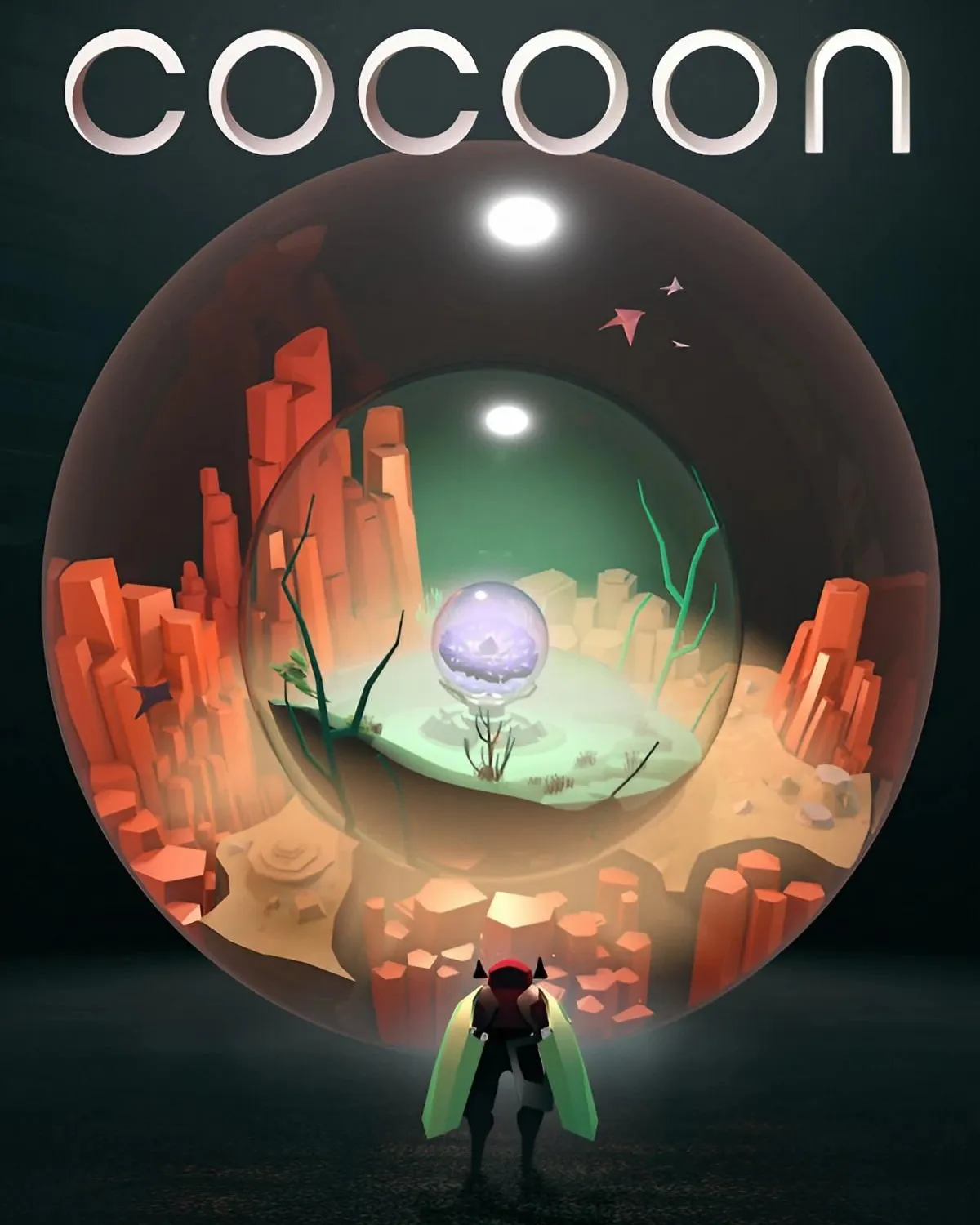
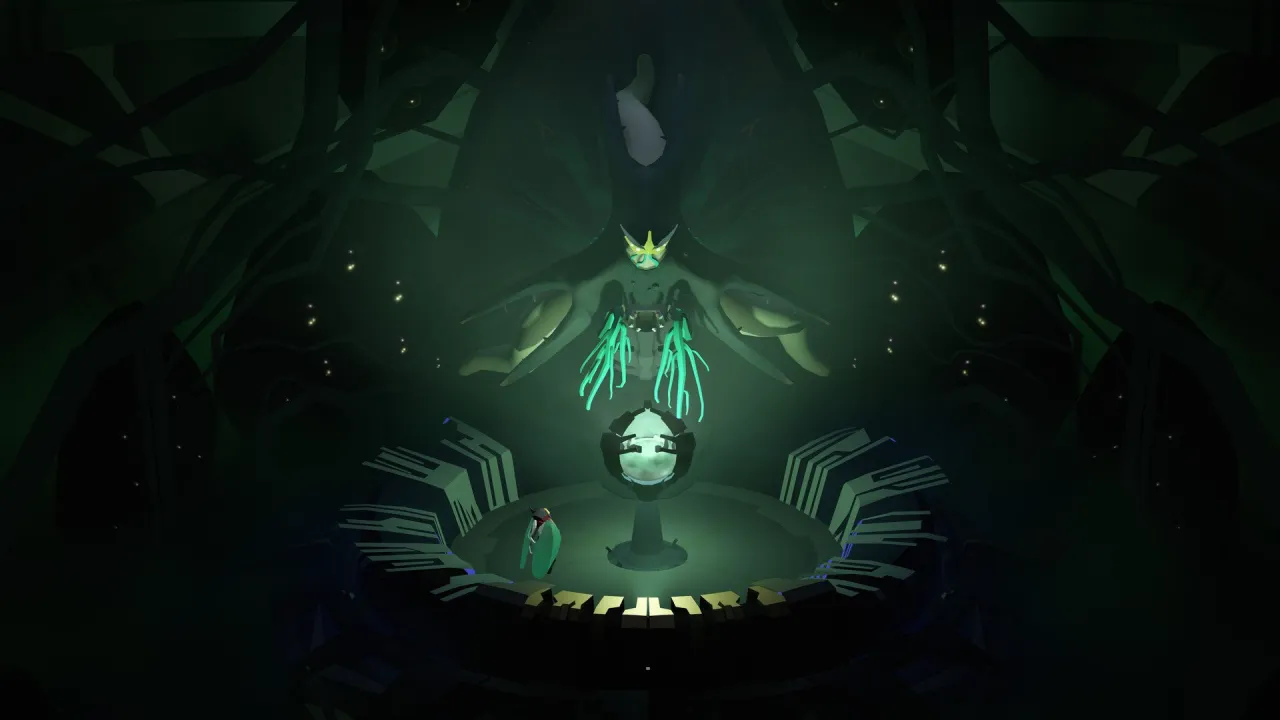
Unlike Carlsen's earlier two-dimensional works, Cocoon uses an isometric perspective in full 3D. The camera sits above, showing a sharp contrast between the little moth and the huge space around it. Stylistically the game gravitates toward minimalism, a restrained, muted color palette and clear geometric forms. The surrounding world looks alien and cold. Everywhere are smooth, sterile, almost textureless surfaces, eerie biomechanical aggregates and insect-like monsters. The action unfolds unhurriedly, giving you a chance to feel the breath of this whimsical, technogenic world. The surreal atmosphere is complemented by excellent sound design and an enveloping electronic soundtrack by composer Jakob Schmid. From literally the first minutes you seem to sink into a state of meditative trance. The hackneyed advertising phrase “from the creators of” is entirely justified here — Cocoon is very much like Limbo and INSIDE.
The game has no interface and no contextual hints. You have to get acquainted with the game mechanics by feel, but this by no means means you will have to wander around aimlessly. The local level design directs the player's attention with intuitive visual markers, and interaction with the environment is carried out with a single button. Saw a glowing switch? Pressed it — a path opened. Picked up a sphere, carried it to the right place — opened two more path options. Pulled a biomechanical lever — set a clockwork mechanism in motion. Activated symbols in the right order — switched on a robot capable of clearing obstacles. The authors managed to build an intricate system of the player's interactions with space using minimal means.
At the same time the gameplay does not feel primitive, largely thanks to the mechanic of teleporting between worlds hidden inside spheres, like the galaxy in the gem from the film “Men in Black”. Thus, by placing a sphere on a special portal pad, your character can dive into another dimension, and there, having solved the necessary puzzles, find yet another orb that hides another location within itself. By swapping spheres on portals, you can instantly return to levels already completed, exploring previously inaccessible zones. In this way Cocoon follows the classic rules of metroidvania backtracking structure, but instead of making the player run from one end of the map to the other, lets you carry spheres like portable biomes. The movement between worlds itself is quick and smooth, without a loading screen.
Besides the teleport function, each sphere has a characteristic property that helps in solving spatial puzzles. For example, the orange sphere makes invisible bridges visible, and the green one lets you climb to heights via special semitransparent columns. Naturally, a given ability can be used only when your moth is holding the right sphere in its hands, which gives rise to chains of intricate logic tasks. Spheres are also used as keys to activate various mechanisms.
In a sense Cocoon also recalls The Legend of Zelda: The Minish Cap for Game Boy Advance, where a small world was hidden inside a big one and Link could move between them with a magic hat. The comparisons with the two-dimensional “Zeldas” do not end there. From a design standpoint the locations in Cocoon are very similar to the classic “dungeons” of A Link to the Past or A Link Between Worlds: tangled mazes, bridges, key hunts and, of course, bosses that seasoned “Zelda” fans are sure to like. The isometric and horizontal projections, that is, that notorious “top-down view”, impose special conditions on the design of boss fights. The enemies' attacks are built on geometrically precise movements: a dash forward, backward or diagonally, the use of all manner of projectiles filling the screen as in the shoot’em up genre, and so on. The bosses seem to draw lines of their actions, which lets the player easily read them visually and then dodge them by choosing the right trajectories. With no means of defense or attack on you, to damage a boss you must quickly assess the situation and use contextual items unique to each arena.
Objectively speaking, the game has practically no obvious flaws — it is an exquisitely polished project that squeezes every drop out of its proposed gameplay concept and does not manage to get boring, not least since a playthrough is unlikely to take you more than four or five hours. On the other hand, Cocoon is so fixated on its perfectionism, aesthetic detachment and “mystery effect” that at some point it begins to be perceived as something absolutely inanimate. Perhaps the talented and extremely meticulous game designer Carlsen lacked a helper at his side with a more chaotic, creative way of thinking who would breathe a bit more human emotion into it.
If you have missed games such as INSIDE, Journey or even ICO, your first action after reading this review should be to try Cocoon. Without a doubt, it is one of the main releases of 2023, which many generations of players and game design analysts will keep talking about.
Based on material from GameMAG. Translated from Russian.