8 Most Illogical Things in Assassin's Creed Mirage
A roundup of eight questionable moments in Assassin's Creed Mirage: ordinary outfits worn over special costumes, healing through the Abbasid rider costume, Basim's strange diet, burning oil jars, a child's leap of faith, the Hidden Ones hiring thieves, the djinn-Loki and William Miles' cameo. Contains story spoilers.
8 Most Illogical Things in Assassin’s Creed Mirage
The series of action adventures in which historical settings sit alongside science-fiction elements needs no excessive introductions. Practically every gamer knows in general terms the key features of Assassin’s Creed: parkour, the Animus device that reads DNA and lets the hero immerse himself in the memories of his ancestors and, of course, a tangled global story involving representatives of the ancient Isu civilization. Making sense of all the twists of the plot and the overall lore (not to mention the complex gameplay mechanics) is no easy task.
At the same time some players consider Assassin’s Creed Mirage somewhat better than previous installments, since its gameplay is noticeably closer to the classic games of the series. Unfortunately, Mirage also has a number of controversial points, some of which are collected below.
Attention, story spoilers for Assassin’s Creed Mirage follow!
Ordinary Outfits Replace Costumes
Besides the standard cosmetic outfits, Mirage also has special costumes that give the main hero special abilities and various advantages. Interestingly, you can use both kinds of clothing at the same time, since they are in two different inventory slots, but you will soon discover that the ordinary outfit is put on over the special costume, in effect changing the main hero's skin.
This looks rather strange, since you keep the perks that come with the costumes. Thus you can calmly use the passive “Lightning Flash” ability created by Milad's costume even when Basim wears the garb of a eunuch or a sick person's white robe. Nevertheless, we have no way to choose the skin of the younger street thief Basim from the prologue — it is the only outfit that does not return as a disguise.
The Abbasid Rider Costume Restores Health
The authors of Assassin’s Creed Mirage chose a rather unexpected way of regenerating health. If you think it is automatically restored after you finish a fight, you are mistaken. Instead you need to find a certain costume and put it on to start a slow regeneration process.
This is the Abbasid rider costume, which when equipped restores a small part of HP every 2 seconds, but no more than half your health and only if the hero has not been detected by enemies. In other words, you will have to constantly change into this costume and hide whenever you need to heal. But what is so special about this garb and where did its healing properties come from? We will get no answer to that question. All we know is that the costume previously belonged to a knight who fought and died on the battlefield. For some reason this unique healing perk did not help him.
Basim's Dubious Diet Works Wonders for His Health
The costume mentioned above is, fortunately, not the only way to restore the main hero's HP. Basim can also be healed with various food, only the protagonist's diet raises some questions. The thing is that the assassin's diet in Mirage consists of leaves from random bushes and stew from pots (which, judging by their look, may well be empty).
Interestingly, Basim simply ignores appetizing-looking products and ready-made meals that can be found at various points on the map. Apparently he prefers to gnaw leaves like a deer, and various delicacies do not interest him at all. Such a diet turned out to be quite beneficial for Basim, since he managed to live to see the events of Valhalla.
Lit Oil Jars Are Placed All Over the Map
Another strange innovation of Mirage is the abandonment of realism in favor of more spectacular kills using environmental elements. This concerns the oil jars that in previous games of the series had to be broken first and then set on fire by shooting a fire arrow into the puddle of oil.
Now, for some strange reason, the jars of oil are already burning, as if before us were huge Molotov cocktails. For them to explode, it is enough to throw a throwing knife at them. At the same time the developers could well have kept the working scheme from previous installments, giving us the chance to first throw a knife at the jar and then set the oil on fire using a torch. Of course, the current variant looks more convenient from a gameplay point of view, but it makes you wonder who walked around the locations and why, setting jars of oil on fire.
Basim Puts a Child's Life at Risk, and the Game Only Encourages It
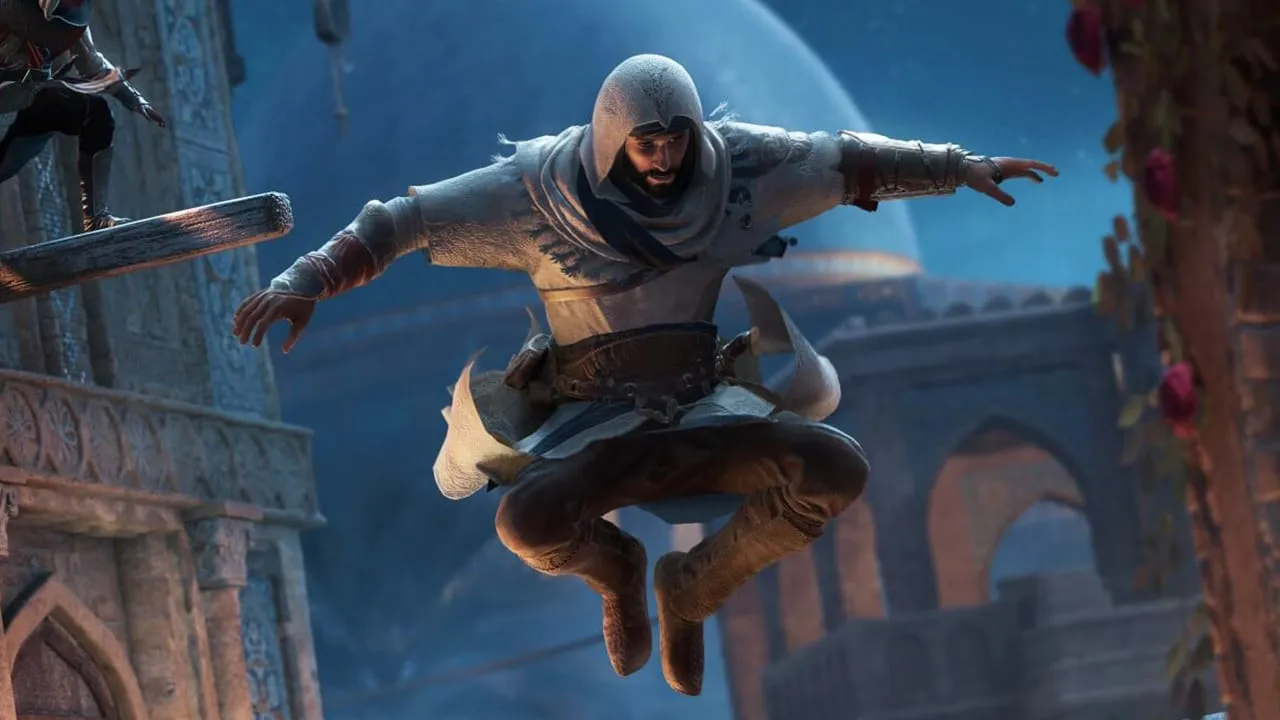
In the region of Karkh there is an unusual viewpoint tower needed for synchronization. It is unusual in that during the climb you will meet a boy named Young Eagle, who will ask you to show him how to properly perform a Leap of Faith.
Anyone else in Basim's place would have talked the boy out of this idea, would have told him it is dangerous and would have asked the child to go down in a safer way. However, the main hero sees nothing wrong with it. He watches the boy jump from a huge height into a haystack, after which he tells Young Eagle that he is still too small to become a Hidden One (this, by the way, is a hint that before us is Haytham from Valhalla).
As a result the game rewards us with the by-now familiar synchronization bonuses, and all the NPC around watch this spectacle with delight. No one is even outraged that an adult man in broad daylight urges a boy to jump off a roof.
The Hidden Ones Rely Too Much on the Services of Dervish
At the very start of the story Basim appears before us as an experienced thief carrying out orders of his comrade Dervish. A bit later the identity of the client is revealed to us, and at this moment logic briefly leaves the story. The thing is that Roshan, a high-ranking assassin with a whole refuge of followers, for some reason hires unreliable random thieves, assigning them to steal important items of the Order of the Ancients.
These are assassins working in the shadows. Such is their motto. What sense is there for assassins to turn to mercenaries and ask them to do work that the assassins themselves train for years? It turns out that Basim's meeting with the Hidden Ones is conditioned not by the narrative's internal logic but only by a sudden demand of the plot.
Part of the Consciousness of the Norse God Loki Was Reborn as a Djinn
If you have already managed to finish Assassin’s Creed Mirage, you will surely agree that the unexpected horror element in the form of a grotesque djinn chasing Basim throughout the game looked not especially fitting. Not only does it not really fit into the overall story canvas, it also has an unjustifiably tangled origin story.
At some point it becomes clear that the djinn personifies all of Basim's suppressed memories of his former life in which he was Loki (in the local lore this god was a representative of the Isu civilization). As is known, in Norse mythology Loki is the god of deceit, and djinn in Arabic folklore are presented as shape-shifting demons. These mythological characters are practically unrelated to each other, so it is rather unusual to see such a strange merger of two images.
Of course, one can argue that before us is not so much a djinn as memories from a past life reinterpreted through the current mythology that Basim grew up on, but it is rather hard to catch the connection between suppressed memories and the frightening, slimy figure that hides in the shadows.
William Miles' Cameo
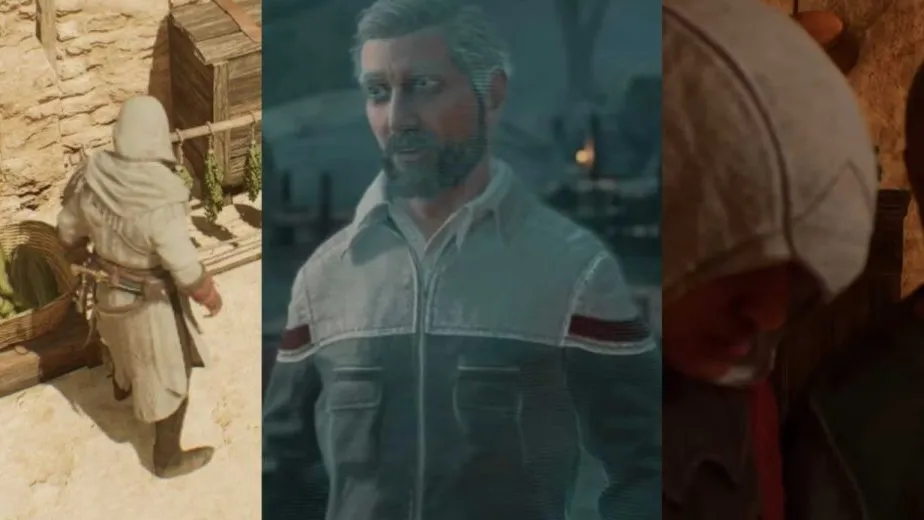
It is time to recall the impressive opening cutscene. The modern assassin William Miles (Desmond's father) appears again in the series, and this time he tells us a short backstory of Basim. Since franchise fans remember that in the finale of Valhalla William and Basim's first meeting took place, it is logical to assume that in Mirage we are awaited by a continuation of that storyline.
Unfortunately, the authors of Mirage fail our expectations, since the game's action never returns to the present, and all events after the prologue unfold in Baghdad of the IX century. So it is unclear whom William is addressing at all in his monologue. Is he breaking the fourth wall, speaking directly to the players? Apparently so, since he certainly does not need to explain anything to Basim.
Based on material from Genapilot. Translated from Russian.